

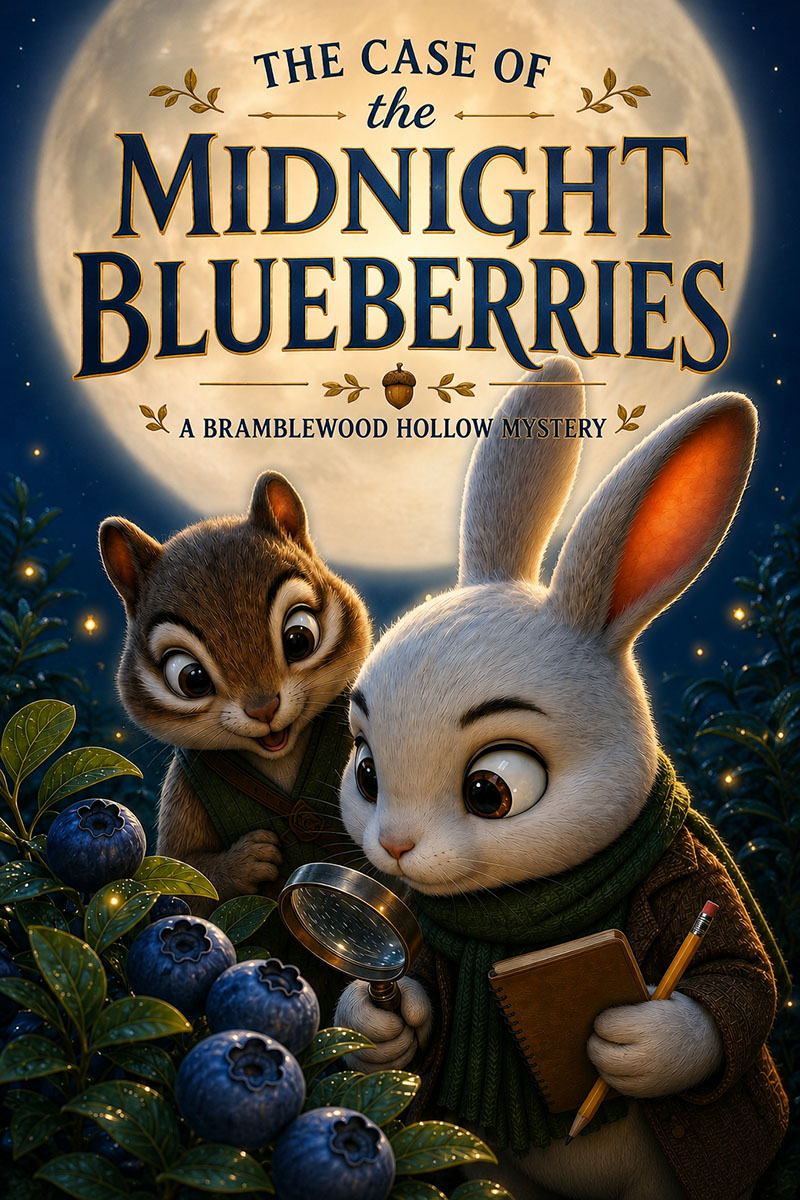
A Bramblewood Hollow Mystery
The Case of the Midnight Blueberries
Chapter One: The Helpful Thief
Rupert Hopscotch was sharpening his pencil when the knock came.
It wasn’t a polite knock, or a patient knock. It was the kind of knock that said someone had been counting things and the numbers had come out wrong.
He opened the door to find Mrs. Pemberlyn Quill the hedgehog standing on his doorstep. Her spectacles were slightly crooked and her quills bristling.
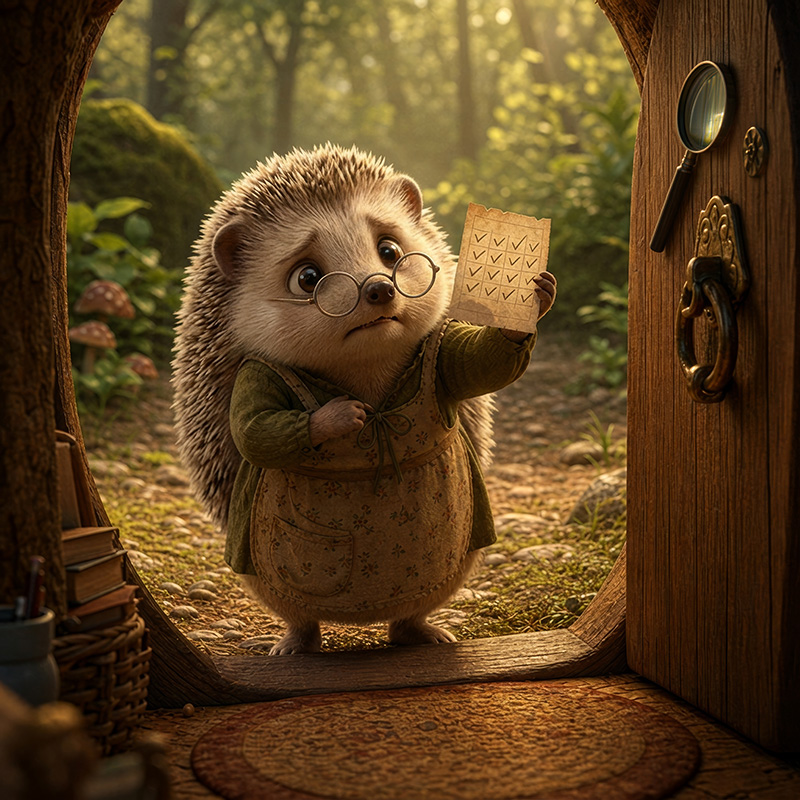
“Rupert,” she said. “I have a case for you. It’s my blueberries.”
She leaned closer, whispering, “Someone is stealing my blueberries.”
“How can you be sure?” Rupert asked, already reaching for his notebook.
Mrs. Quill pushed her spectacles straight. “Because I counted all the blueberries twice yesterday evening. Two hundred and thirty-six. And I counted twice again this morning.” She held up a scrap of paper covered in tiny, proper tick marks. “Two hundred and thirty.”
“Six missing,” Rupert said.
“Not five. Not seven. Six.”
From somewhere deeper in the burrow behind Rupert came a scrambling sound, and Thistle Theodore Nutwhistle the chipmunk burst into view with his satchel already over his shoulder.
“A case!” Thistle’s eyes were enormous. “Did she bring a case? Is it a case?”
“Not that kind of case, Thistle,” Rupert said.
“Right, right—a mystery case!” Thistle was already bouncing toward the door. “Even better!”
“These are not just any blueberries, Rupert,” Mrs. Quill said, puffing out her chest. “I have been tending these particular bushes for my Famous Blueberry Buckle. You know I bake it every year for the Berry Bounty Banquet!” Her voice trembled. “The banquet is in a mere two days, Rupert! We’re celebrating the first foods Bramblewood settlers thrived on. But if this thief continues taking six berries every night, I won’t have enough to fill the baking dish. The centerpiece of our celebration will be empty!”
She held up a paw, her eyes widening behind her crooked spectacles. “Each berry is fat and sweet, and a deep, perfect shade of midnight blue. Sometimes I look at them growing quietly there on the branch and think they look like tiny, living works of art.”
Her proud expression crumbled, and her quills gave a sharp rustle.
“But the count has been dropping for days. Someone is definitely helping themselves to my prize crop.”
“Whoever is taking them is very tidy about it,” she added. “No broken branches, no trampled leaves. But my count is flawless. There are six fewer berries each morning.”
“But that’s not the strangest part.” Mrs. Quill peered at them over her spectacles. “My garden gate is made of woven reeds. It’s had a rather large hole for months. Yesterday morning, I noticed the broken reeds had been repaired and even sealed with resin. It’s beautiful. The new pieces fit so superbly you can’t even see the join.”
Rupert looked up from his notes. “Someone repaired your gate? Without being asked?”
“That’s what I said! Now, why on earth would someone steal my blueberries and fix my gate?”
Rupert tapped his pencil against the page. That was a very good question indeed.
The three of them walked together to Mrs. Quill’s garden at the edge of Bramblewood Hollow. Her orderly rows of blueberry bushes stood along a low thatched fence next to the pond. Rupert examined the bushes first. The missing berries had been plucked with care—each stem flawlessly parted, not a branch broken or a leaf out of place.
Then he crouched beside the gate, holding his pencil in front of it horizontally while squinting one eye. The new reeds had been precisely shaped, tucked, and woven. Rupert ran his paw over the expertly made repair, noticing a smooth glaze of pine resin coating the reeds. “Delicately laid resin. Seamless,” he murmured. He had to look twice to see where the new work began and the old gate ended.
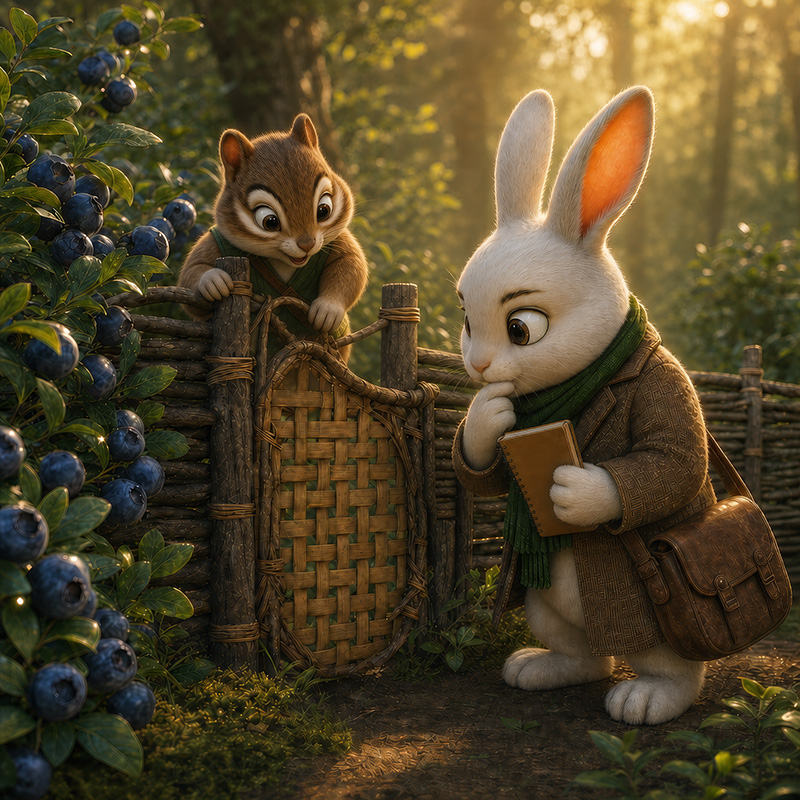
He wrote in his notebook: Fine skills. Artisan. Picture perfect.
Thistle called from the far side of the garden. “Over here, Rupert! Look at this!” He was pointing at the top of the fence, bouncing on his toes. A muddy print was partially smeared across the peak of it—except for the distinct outline of webbed toes where someone had grabbed on tight and swung themselves up and over.
“Good eye, Thistle,” Rupert said, and he meant it.
Thistle puffed up with pride. “I bet there are more clues! I’ll check the rest of the fence!” And he was gone before Rupert could say another word.
Rupert crouched lower. He peered beyond where those webbed toes had gripped the fence top, his eye landing on a patch of soft mud just outside the garden fence. There, stamped clearly into the bank, was a single footprint. The toeprints dug deep into the mud, exactly the mark a swimmer would make when pushing off into the water. Those webbed toes pointed directly out into the pond, leading away from the garden. “That’s the direction our thief exited,” Rupert murmured to himself.
Rupert knelt down and opened his notebook to a fresh page. The footprint was medium-sized, with a distinct fan of webbing between the toes. His pencil moved delicately, capturing the precise spread of the fan shape. Webbed toes. Interesting. He blew a tiny cloud of graphite dust off the page, using his thumb to smooth a soft shadow’s edge. He was just starting on the outer curve of the foot when—
WHOOOOSH.
Thistle came skidding past at full speed, his tiny paws churning through the mud like a very enthusiastic eggbeater. The footprint disappeared under a spray of muck.
“Did you find something?” Thistle asked, sliding to a stop with mud up to his elbows.
Rupert looked at the smeared ground. He looked at his half-finished sketch. He looked at Thistle’s muddy paws, which were planted plumb in the middle of where the footprint used to be.
“I did find something,” he said. “It was very helpful. I wish I’d had about three more seconds with it.”
Thistle looked down. “...Oh.”
“Yes,” said Rupert. “‘Oh.’”
He held up his notebook. The partial sketch showed the webbing clearly, but the outline of the foot—the part that would have told him precisely which animal had stood here—was gone.
“Whoever our berry-picker is,” Rupert said, gazing out over the water, “they must have crossed this pond.”
Chapter Two: The Fastest Wrong Answer
The pond at Bramblewood Hollow was broad and calm, ringed by willow trees and cattails. It was where half the Hollow came to cool off, skip stones, or simply sit and think.
The morning was warm, and the waterside was busy.
At the farthest edge of the pond, a large mound of sticks and mud stood like a compact, cleverly built island—the lodge where Aspen Twig-Nipper the beaver lived.
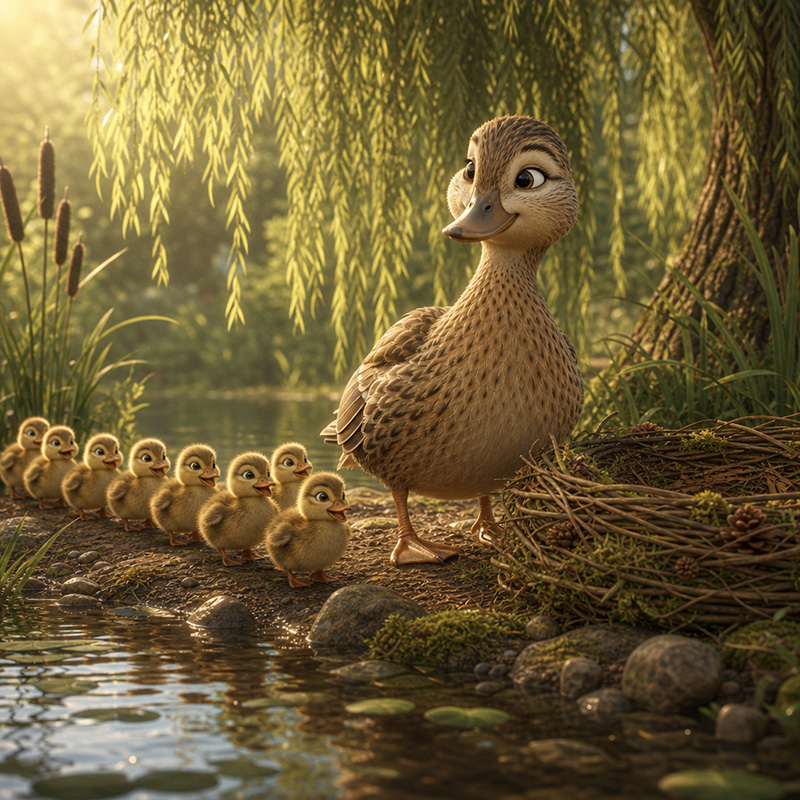
In the near shallows, Penelope Puddle-Walker the duck was paddling. Her ducklings trailed the shore behind her in a wobbly line. One by one they launched into the water, zooming like fuzzy little water darts following mama.
Their nest sat empty on the bank—a grand creation of tightly woven reeds and river-grass, lined with the finest pine needles Penelope could find. She was particular about her materials. Each morning she made a low-slung pass above the place where the creek fed into the far side of the pond, skimming the surface for pine needles that had drifted down overnight. “Nothing is softer for little ones to sleep on,” she always said. “And my own feathers do the waterproofing—there’s nothing better.”
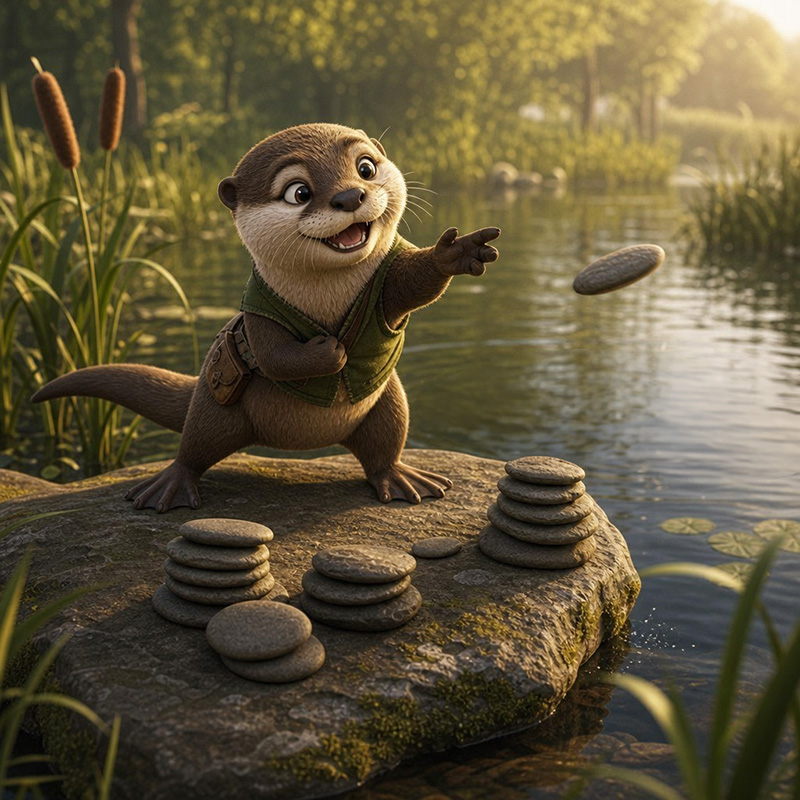
Down by the reedy water’s edge, Barnaby Stream-Racer the otter was perched on a flat rock, fine-tuning his stone-skipping technique—one, two, three, four skips! With each new record, he chittered with triumph, wiggled his webby little toes, and spun around his skillfully stacked piles of smooth skipping-stones.
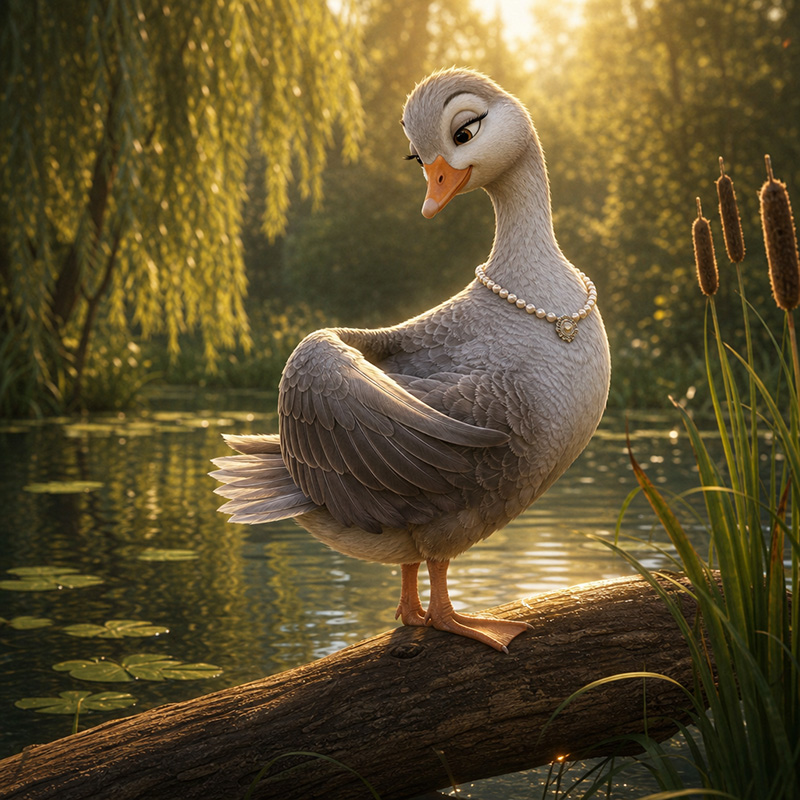
On a sunny log that rose out of the pond, Preena Waddleton the goose stood smoothing down every single feather with the concentration of a fine artist painting a picture. She had chosen the log carefully—it caught the morning light at precisely the right angle. Preena believed everything should look its best—and she had the patience to make sure it did.
Rupert and Thistle walked along the pond’s bank, searching for more clues. Aspen Twig-Nipper was floating lazily, carrying a tree branch in his mouth. He was humming a tune to himself, when a sudden yawn overtook him. He nearly fumbled the branch.
When he spotted Rupert and Thistle on the bank, Aspen let the branch drift and paddled over, resting his broad chin on the edge of the dock. “Morning, Rupert. Morning, Thistle.” He stifled a yawn behind one large paw. “Pardon — late night. I’ve been patching the lodge walls. Every autumn it’s the same.” He shook his head in the weary way of someone whose maintenance list never gets shorter. “Looking into something?”
Rupert told him briefly about Mrs. Quill’s missing berries.
Aspen’s expression shifted—genuinely troubled, in the way of someone who takes his neighbors seriously. “That’s not right at all,” he said. “Especially with the Banquet coming. If you need an extra pair of eyes on the water, say the word.” He gave his tail a slow, sincere wave, retrieved his branch, and paddled back toward the lodge.
Rupert watched him go, then turned back to his notebook.
Thistle was shifting from foot to foot, and glanced down at his own toes sinking into the soft bank. “Wait a minute!” he said, bouncing on his toes so fast he was practically vibrating. “If the berry thief crossed the pond, they had to wade into the water somewhere, and crawl out somewhere else! That means more tracks! I’ll check every single inch of the shoreline. Back before you can say ‘chipmunk’!”
“Thistle, maybe we should think about this before —”
But Thistle was already gone.
What followed was not Thistle’s finest moment as an investigator.
He rocketed along the shoreline so fast that Penelope’s ducklings scattered in six different directions.
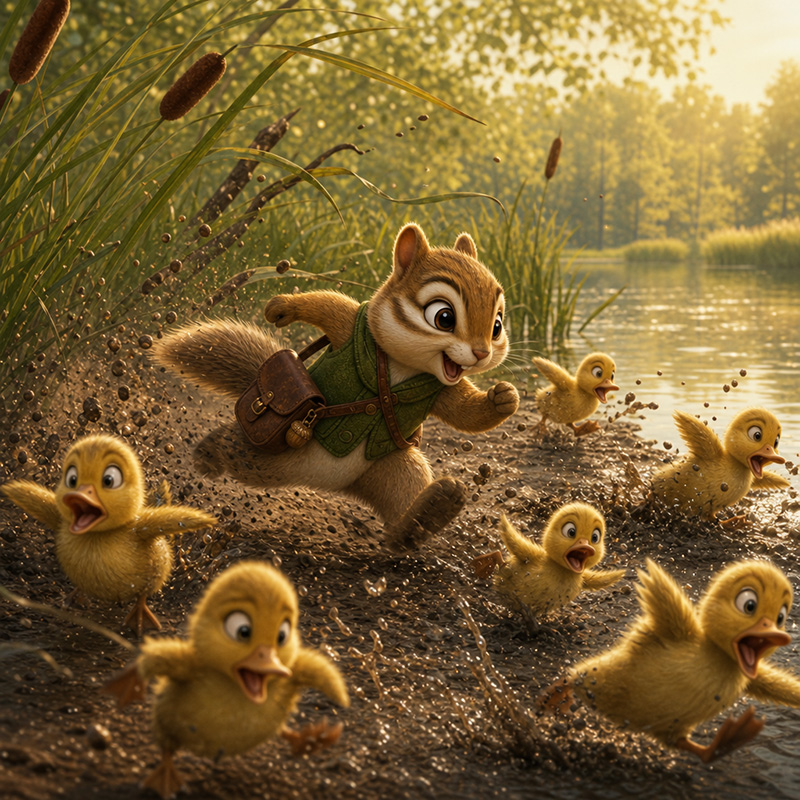
“Sorry!” Thistle called over his shoulder—without slowing down.
Penelope gave a very stern QUACK that echoed across the water.
“I’ll fix it later!” Thistle added, already too far ahead to do any such thing.
He tripped over Barnaby’s artfully stacked skipping-stone piles and sent them flying skyward. Barnaby darted and dodged as the stones rained back down, and Thistle flinched mid-stride.
“Oh no—that was a good pile—”
But momentum carried him onward.
Thistle’s speed reached its peak as he dashed past Preena. Three of her magnificently groomed feathers popped straight up like exclamation points.
“Thistle Theodore Nutwhistle!” Preena honked.
That was a honk even Thistle could understand.
He winced.
He kept going.
A moment later, a family of frogs launched themselves out of the cattails in startled protest as he tore past.
When Thistle finally skidded back to Rupert, he was coated head to tail in mud and cattail fluff, with a tiny, bewildered tadpole sitting squarely on his head.
“I may have gotten a little carried away,” he panted, catching his breath. Then, more briskly, as he peeled a sticky, amber-colored lump from the bottom of his foot and flicked it to the ground, “Nothing found. No tracks anywhere. I checked both sides. Twice.”
“Or perhaps,” Rupert said mildly, “there were tracks before you zoomed through them.”
He gently lifted the tadpole from Thistle’s head and set it safely in the shallows. “But either way—let’s go apologize.”
When Rupert and Thistle reached Penelope, most of her ducklings had returned to their nest. The last two were still hiding in the reeds. Rupert explained that the wild chipmunk would not be making another run through.
While Rupert helped guide the last two ducklings back from the reeds, he found himself crouching eye-level with Penelope’s feet. Three toes, narrowly webbed—nothing like the broad, fanned print from the garden bank.
He added a quiet note: Three toes. Fan too narrow. Not a match.
“Thank you for being so understanding, Penelope,” he said as he stood.
“Well.” She smoothed a feather pointedly. “I trust the case will be settled before the Banquet.”
When they found Barnaby, he was still rebuilding his knocked-over stone towers.
Rupert picked up a few and handed them over.
Barnaby gratefully accepted the returned stones. His small webbed paws flashed in and out of the water as he quickly washed and stacked them. Rupert watched for a moment. It was very neat and precise work, and the paws doing it were surprisingly small. Barnaby caught Rupert watching his paws and smiled. “Oh, sorry to work while we’re chatting, but I always have to give the stones a quick rinse. Sticky stuff washes down from up the creek sometimes—that stuff can ruin a good throw!”
Rupert compared the small paws to the memory of the drawing he’d started at Mrs. Quill’s—before Thistle redesigned the mud. He penned another entry in his notebook: Paw span too small. Web spread doesn’t match.
Rupert offered a polite bow to Preena, who was still smoothing down the three feathers Thistle popped up.
“My apologies for the breeze, Preena,” Rupert said.
Preena huffed gently. “A true artist needs quiet to appreciate color, Rupert! Why, just an hour ago I was inspired by a strange drift of blue floating near the creek inlet, but now my morning thoughts have been ruined by that flying chipmunk!”
Rupert thanked her, and as he turned from the log, his eye caught a flash of bright purple on the far shore. Waldo Diggins the woodchuck was kneeling in his blackberry patch. He was a large, round, gentle-looking fellow, and he was wearing a pair of purple gardening gloves absolutely covered in dark berry juice.
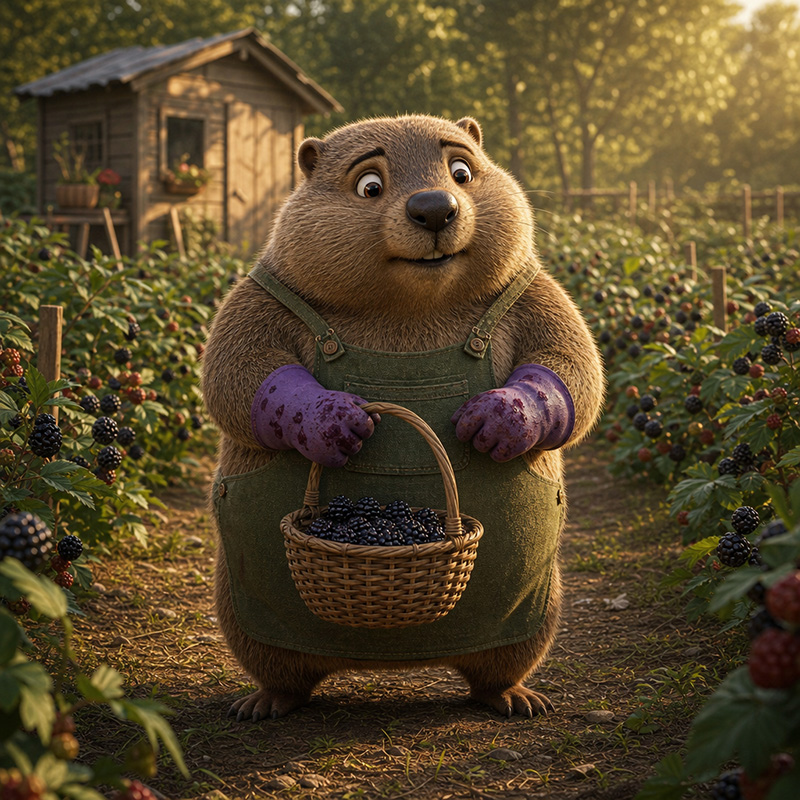
When Thistle noticed where Rupert was looking, he gasped. His eyes went as wide as saucers. He pointed one dramatic paw straight across the water.
“RUPERT! Look at his hands! They’re covered in blueberry juice! He’s been stealing Mrs. Quill’s blueberries! Case CLOSED!”
“Thistle, those are blackberries. He grows them. And those are his gardening gloves, not his —”
But Thistle had already spun around to share his discovery with Penelope, Barnaby, and Preena, and the news moved through Bramblewood Hollow the way news always does—quickly, and not entirely accurately. By lunchtime, the story had grown from “Waldo might have taken some blueberries” to “Waldo definitely ate Mrs. Quill’s blueberries” to—by the time it reached the far side of the Hollow—“Waldo ate Mrs. Quill’s entire garden and possibly part of her fence.”
Rupert waited until the commotion had drifted a little way down the shoreline before crouching to pick up the lump Thistle had discarded.
It was firm, but slightly tacky to the touch. Translucent amber, with a faint golden glow when it caught the light. Pretty. He turned it over between his fingers, then brought it closer to his nose and inhaled.
Pine resin.
Rupert glanced around the shore. Willow branches trailed in the water. Cattails whispered in the breeze. Mud, reeds, smooth stones.
No pines. Whoever used resin could have brought it from elsewhere.
Rupert slipped the resin into his coat pocket. He looked around at the whispering neighbors. A cloud of suspicion was settling over the Hollow. If he didn’t solve this quickly, the banquet would be ruined before it even began. He closed his notebook with a soft tap and glanced across the pond to Waldo. He needed to get to him before the story did.
He hurried around the muddy shoreline path toward the blackberry patch. But gossip travels faster than even a rabbit on a mission.
As Rupert walked, he glanced at the villagers. First one head turned. Then the bobbing line of ducklings froze. Preena Waddleton stopped mid-preen to point a wing across the water. One by one, a dozen pairs of eyes fixed on Waldo Diggins.
By the time Rupert reached the brambles, Waldo was standing with a half-filled basket, looking entirely bewildered. He blinked at Rupert. “Good morning, Rupert,” Waldo whispered, glancing nervously at the far shore. “Is it just me, or is the entire village staring at me like I’ve suddenly grown a second tail?”
“Not a second tail, old friend,” Rupert said gently, stepping up beside him. “But I’m afraid you’ve found yourself at the center of a story you haven’t been told yet.”
Rupert filled him in on Mrs. Quill’s missing berries, the midnight gate-fixer, and the village’s sudden suspicion of anyone wearing bright purple.
Waldo, who was shy enough on a good day, stared at his own hands. Then, he let out a laugh that surprised even himself. He held up his purple-gloved paws, shaking his head in helpless amusement.
“But I’ve been nowhere but here!” he said, catching his breath between chuckles. “These are blackberries. And as for eating Mrs. Quill’s fence—” He glanced down at his gloves, then back at Rupert with a wry smile. “Well, I’ve got my limits. A wooden fence would give me terrible indigestion.”
He shook his head. “Let them talk. Word gets around, and so does the truth eventually. You’ll set it straight, Rupert. I’m not worried.”
Rupert sat by the pond that evening as the sun turned the water pink and gold. He turned the pages of his notebook back to the partial sketch from the garden. Webbed toes. He looked out at the darkening pond—at Penelope settling her ducklings, at Barnaby doing one final skip before bed, at Preena tucking her bill neatly under her wing, at Aspen’s lodge sitting cozy and quiet at the far side of the water.
Plenty of webbed feet in Bramblewood Hollow. But a woodchuck didn’t have them. And Waldo certainly couldn’t have made that artistic repair to Mrs. Quill’s garden gate. Woodchucks were excellent at shifting earth, but they worked more in demolition than design. Mrs. Quill’s gate required an intricate weave, with everything balanced just so.
Back in his burrow that night, the quiet shhh-shhh of Rupert’s small sharpener filled the room as he brought his pencil to a perfect, clean point. He looked out the window of his office toward the dock where the Water-Cricket bobbed lightly against the wood.
“We’re painting the wrong picture,” he murmured to the evening air. “The culprit didn’t approach by land. They prefer water.”
Chapter Three: Following the Midnight Blue
Around midnight, when the rest of Bramblewood Hollow was fast asleep, Rupert tapped on Thistle’s door.
“We’re taking the Water-Cricket out,” he whispered.
“Yessss!” Thistle gasped quietly, his tail-tip twitching with barely contained energy. “A midnight stakeout!”
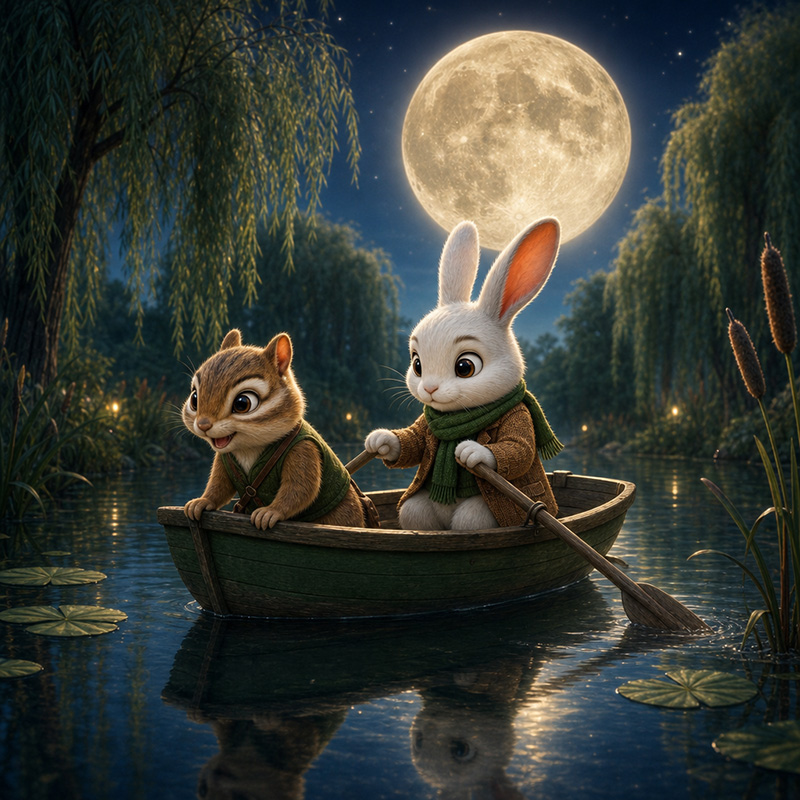
The Water-Cricket was Rupert’s pint-sized wooden rowboat, painted green with her name lettered cleanly along the stern in white. She was sturdy, reliable, and patient—which was lucky, because Thistle was none of those things when sitting in a boat.
The full moon hung enormous above the treetops, flooding the pond in such keen, colorless light that every detail—every ripple, every floating scrap—appeared so clear it looked like magic.
“Do we have to row?” Thistle asked, hopping from paw to paw on the shoreline. “I could swim. I’m a very strong swimmer. Very fast.”
“You can’t swim and look for clues at the same time.”
“I absolutely can. I can do at least three things at —”
“Thistle. In the boat.”
They pushed off into the silver light. Rupert began to row, slow and steady, keeping close to the pond’s shore. The only sounds were the gentle dip of the oars and the quiet creaking of Thistle shifting his weight from side to side and back again.
“Sit still,” Rupert said.
“I’m looking for clues.”
“You’re rocking the boat.”
“I’m looking for clues energetically.”
They had made it about halfway around the near edges of the pond when Rupert lifted the oars and let the Water-Cricket drift. A single leaf was floating past the bow, spinning lazily in their gentle wake. Thistle spotted it instantly, scooping it out of the water.
“Rupert. Look at this.”
On the leaf’s surface was a vivid smear of deep blue—dark and saturated, it absorbed the moonlight instead of reflecting it. Not the greenish-blue of pond water, not the pale blue of reflected sky, but something richer. A color that absolutely didn’t belong on a floating leaf.
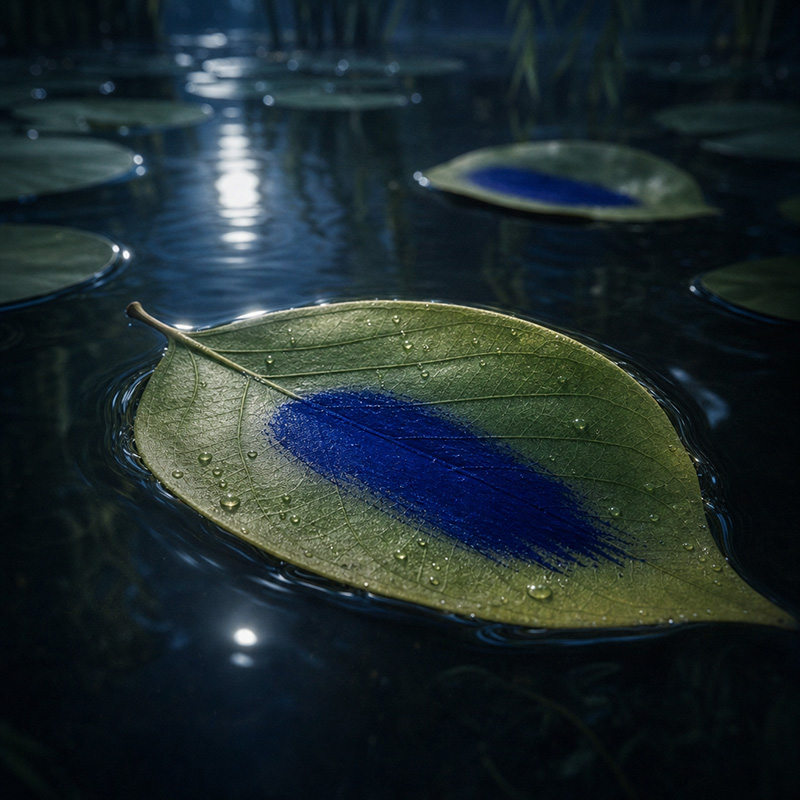
“It’s pretty,” Thistle said, holding it out. “But why is the leaf blue?”
Ahead of them, a second glinting leaf drifted past, then a third. Because the night water was so calm—stirred only by a modest trickle from the creek—the leaves traveled in a slow, obedient line. Rupert touched the smudge with the tip of his paw. It came away dark and sticky.
He sniffed it. “Blueberry,” he said quietly.
Thistle’s head snapped up. “Blueberry? On a leaf? In the water?”
“Why would a thief bring them so far just to eat them?”
“This isn’t a messy smudge from someone eating,” Rupert said slowly, studying the leaf.
“Look at how clean the edge is, Thistle. It’s a deliberate swipe.”
“A swipe? Like what?”
“Like someone testing a paintbrush—making sure they got the color right on the nose.”
Rupert watched the trail of blue-tipped leaves drifting one after another from the same direction. “And whoever is testing this color is really fine-tuning that blue to look its best.”
He took up the oars and began to row, following the floating trail. They pulled away from the near shore, past the cattails and the willows following the blue-leaf trail. And as they rowed, Rupert realized precisely where the leaves were leading them.
The island-like mound of sticks and mud, artfully put together between the far edge of the pond and the nearby creek.
Aspen Twig-Nipper’s beaver lodge.
They brought the Water-Cricket alongside and Rupert tied her to a stout branch poking out from the lodge wall. Up close, the structure was bigger than it looked from shore—a wondrous dome of woven sticks and skillfully packed earth, solid and well-built.
On a dry ledge near the entrance, Rupert’s eye caught a curious sight: several old paintbrushes in need of new bristles, sitting waiting in clay jars.
As they sat quietly in the boat, a thick, sweet scent wafted down from the loose opening at the very top of the lodge. Rupert inhaled.
It was the rich aroma of crushed blueberries, mixed with something else—warm, resinous, and pleasantly sharp.
A scent he knew.
Rupert glanced, for a split second, toward his coat pocket.
Then, from deep inside the lodge, came sound. Not the daylight sounds of gnawing or splashing you might expect from a beaver’s home —not the sharp crack of teeth on wood or the splash of a heavy tail. This wee-hours noise was a soft, cheerful, preoccupied little hum. It was followed by a faint, rhythmic clink... clink... clink, like a small wooden stick stirring something inside a hollow clam shell.
Suddenly the humming came nearer. A paw poked out of a little window and flung a leaf. It landed in the small trickle that came from the nearby creek.
Rupert looked at Thistle. Thistle looked at Rupert. For once in his life, the chipmunk was completely still, except for his ears twitching toward the sound.
“That doesn’t sound like a thief secretly eating stolen berries in the dark.” Thistle whispered.
“No,” said Rupert, a slight smile forming on his face as the pieces finally fell into place. “It sounds like an artist working late.”
Chapter Four: The Color of the Sky
Rupert rapped his knuckles politely against the thick wooden door of the lodge.
The cheerful humming stopped instantly. The rhythmic clink-clink inside froze. There was a sudden, frantic rustling sound—like a heavy tail scrambling across dry leaves—followed by a loud THUD, a soft “Ouch!”, and the hurried patter of webbed feet.
Slowly the door creaked open. Aspen Twig-Nipper peeked out, a frantic smile plastered across his face—and a smudge of deep midnight blue ran across the bridge of his nose.
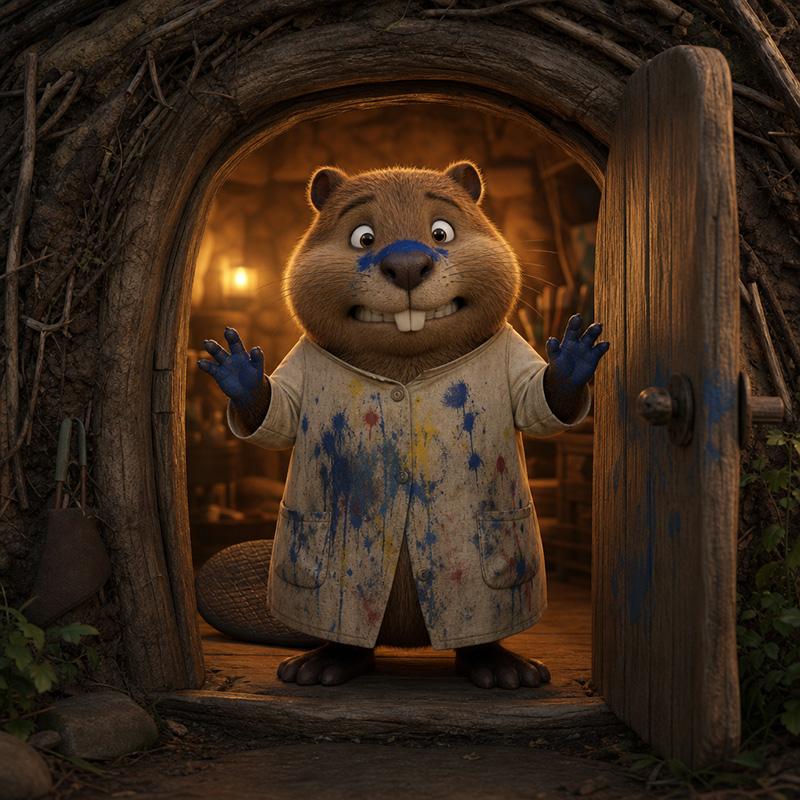
“Right on the nose,” Rupert murmured. “Just like the leaf.”
“Rupert! Thistle!” His voice came out about an octave too high. “What a—what a lovely surprise! I was only—this isn’t—I was doing some, uh, cleaning.”
“Good morning, Aspen,” Rupert said respectfully, giving a polite nod as he tucked the ends of his green scarf into his tweed coat. “May we come in? We’ve been following a trail across the pond, and it seems to have brought us to your doorstep.”
“Oh! Yes, of course, please,” Aspen stammered, pulling the door open barely wide enough for them to pass.
But the moment Rupert ducked through the entrance and Thistle squeezed in behind him, the beaver scrambled ahead, spreading his arms wide attempting to block the entire curved wall of the lodge with his body. It wasn’t working. He was wearing a paint-splattered smock. His paws were stained deep blue. And on the stool behind him sat a freshwater clam shell filled with shimmering midnight-blue liquid, with three blueberries beside it.
“Cleaning,” Rupert repeated, looking at the wall.
“Yes. Very messy in here. You know how it is. Beaver lodge. Sticks everywhere.”
As Aspen rambled, Rupert bent slightly and picked something up from the floor near Aspen’s workbench—a thumbnail-sized, amber-colored fragment, half-stuck to a tarp.
It clung faintly to his paw.
Sticky. Resinous. Memorable.
Rupert turned it once between his fingers. Another piece of pine resin—the exact twin of the chunk sitting in his pocket. He slipped it into his pocket beside the first with a quiet, knowing nod.
Aspen shifted from foot to foot, trying to stretch his arms even wider. But his frantic movement caught the large cloth draped along the back wall. The fabric slipped by a mere whisker—just enough to reveal a vibrant, luminous streak of midnight blue hiding underneath.
“Aspen,” Rupert said kindly. “May we see what’s behind you?”
Aspen blinked. Then his shoulders dropped. His tail drooped flat against the floor. Slowly, with the air of someone who knows the game is up, he reached back and pulled the cloth away.
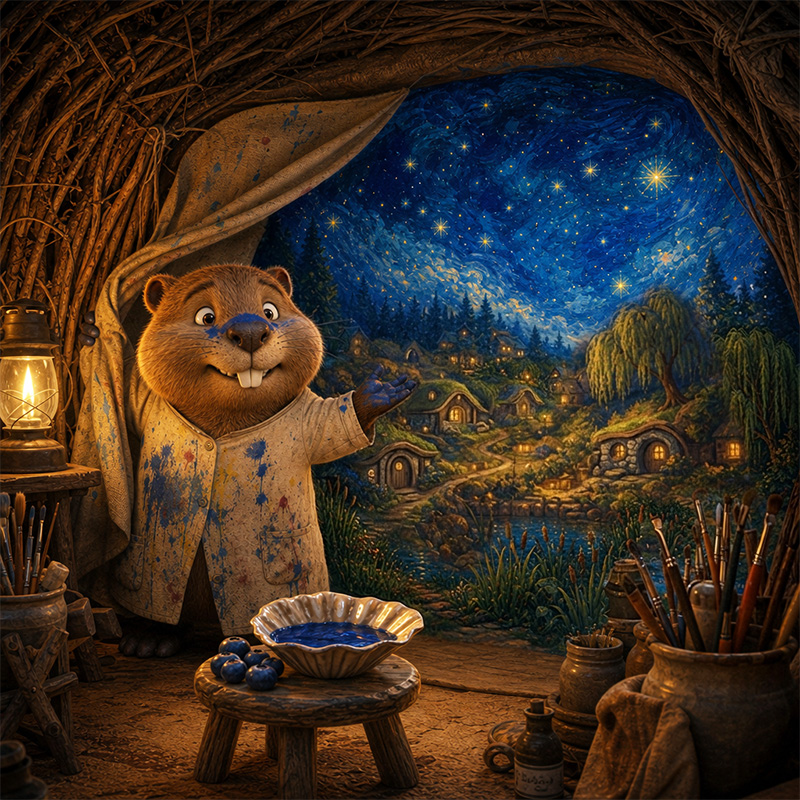
Behind him, fitted snugly against the curved wall of the lodge, was an enormous painted canvas.
It was Bramblewood Hollow.
Every home, every winding path, every garden—all in rich, glowing detail. There were Mrs. Quill’s blueberry bushes, heavy with fruit. Waldo’s blackberry patch with its tidy rows. Penelope’s ducklings in their wobbly line. Barnaby mid-throw on his flat rock. Preena on her log, every feather gleaming. Even Rupert’s own front door, with the little magnifying glass carved above the knocker. And over everything, stretching from one side of the painting to the other, swept a glowing, deep midnight-blue sky full of stars.
Nobody said anything for a long moment.
“It was you,” Rupert said softly.
Aspen sank onto his stool. “I wanted it to be a surprise. For the Berry Bounty Banquet—a painting of our whole village, so everyone could see how beautiful Bramblewood Hollow really is.” He looked at the clam shell of blue paint. “Mrs. Quill’s blueberries make the most perfect midnight blue I’ve ever found. I tried elderberries. I tried blackberries. I tried everything. Nothing else could come close to that heavenly shade. I only took six at a time, so there’d be enough for one night’s painting…” He looked at his stained paws miserably. “I really thought she wouldn’t notice.”
“She counts them,” Thistle said. “Twice.”
“And you fixed her gate,” Rupert added.
Aspen nodded. “I saw the hole one night and I couldn’t bear to leave it like that. I thought—well, I thought maybe it would make up for the berries a little.” He stared at the floor. “It didn’t, did it?”
“It was kind,” Rupert said. “But it doesn’t replace asking.”
Rupert reached into his coat pocket and drew out the small amber fragments. Both caught the light as he turned them between his fingers.
“The gate was neatly done,” he said. “Smoothed and sealed. Pine resin, warmed just enough to flow, then set again without a seam.” He glanced up at Aspen. “The same resin that found its way onto Thistle’s foot… and into your lodge.”
Aspen’s ears drooped. “I didn’t think anyone would notice that either. Pine branches and bits of resin drift down from the creek above my lodge all the time, it’s wonderfully handy. And I have more reeds than I can possibly use myself.”
“It’s not easy to notice,” Rupert said gently, placing the fragments back into his pocket. “Unless you’re looking for what doesn’t belong.”
They rowed back to Bramblewood Hollow together, with Aspen’s broad tail hanging over the stern of the Water-Cricket and nearly dragging in the water. Thistle, for once, sat totally still. With a heavy beaver on board, the boat was riding so low that the pond water was only a whisker-width away from spilling over the sides. Thistle quickly calculated that if he so much as sneezed, or even blinked too energetically, the Water-Cricket would instantly become the Underwater-Cricket.
When the boat finally scraped against the wooden dock, Thistle let out a breath he felt he’d been holding since the center of the pond. Rupert tied the ropes securely, then looked up toward the hill. Bramblewood Hollow was entirely dark. “It is far too early to knock on doors,” Rupert whispered, checking his pocket watch by moonlight. “An apology at two in the morning is just a rude awakening.” Aspen looked down at his blue-stained paws, his tail twitching nervously. “I won’t sleep a wink until I make it right.”
Rupert put his paw on Aspen’s shoulder. “You know what helps me think? Marshmallows. Come with me.”
They crept quietly up to Rupert’s burrow, careful not to wake the sleeping neighbors. Behind the cottage, safe from view, Rupert built a small, tidy fire in his stone pit while Thistle disappeared into the pantry. The chipmunk returned a moment later, staggering under the weight of a jar of marshmallows nearly as large as he was.
Rupert handed out the sticks, and for a while the three of them sat and watched the fire. Thistle, naturally, set his first marshmallow completely ablaze, waving his stick around frantically like a tiny sparkler before devouring the charred remains with great satisfaction. His second marshmallow met the same fate. His third he simply held directly in the flame on purpose, having apparently decided this was his preferred method.
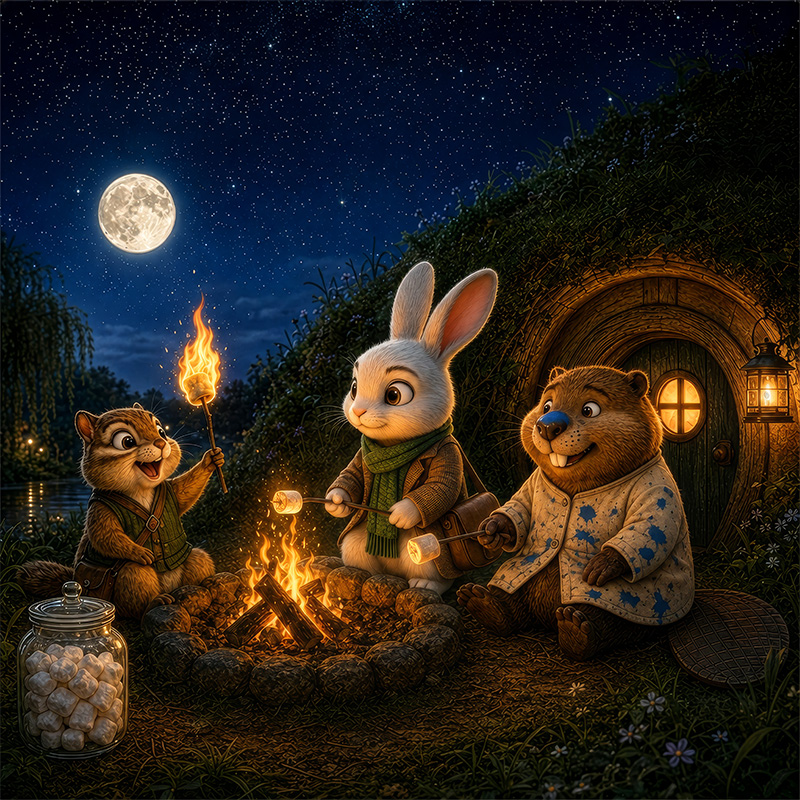
Even Aspen had to laugh.
Rupert took his time with his own—turning it slowly, patiently, until it was evenly golden on every side. He pulled it from the stick in one clean piece and ate it thoughtfully, gazing at the embers.
Aspen’s first few marshmallows barely got toasted—he kept forgetting to hold the stick close enough, his mind clearly somewhere else. But as the fire crackled on, his shoulders settled. He shifted on the grass, stretched his big flat tail out behind him, and finally held a marshmallow low and steady over the coals until it puffed and browned. He ate it slowly, and reached for another.
Nobody talked about blueberries, or paintings, or apologies. Thistle chattered happily about whether frogs dream, and whether moon-toasted marshmallows taste different from sun-toasted marshmallows, and whether a chipmunk could theoretically roast a marshmallow while running. Rupert offered the occasional “hmm” and “unlikely.” The sweet, woody smoke drifted up into the cool night air.
As the sky softened from deep midnight blue into a hazy lavender, Thistle’s energy finally caught up with him. His eyelids grew heavy, his stick drooped, and with a soft sigh, he curled up right there on the grass, snoring like a tiny buzzsaw. Rupert smiled, tossing one last small twig onto the embers. Aspen was breathing easily now, his paws resting open on his knees. He looked up at the lightening sky, then back at Rupert, and gave a quiet nod.
The first morning light was just beginning to strike the tips of the willow trees when Rupert gently nudged Thistle awake.
“Come on, sleepyhead,” Rupert murmured. “The sun is up. It’s time to go to Mrs. Quill’s.”
Thistle sat up with a start, crossed his eyes, and tried to lick sticky white marshmallow fluff from the tip of his nose.
The village was just beginning to stir as they walked the winding path toward the edge of the pond. Mrs. Quill was standing behind her neatly repaired reed gate, staring at her bushes, and let out a sigh.
Aspen took a deep breath, cleared his throat, and apologized—simply and sincerely, without excuses.
“The painting was for everyone,” he said. “But your blueberries are yours, and I should have knocked on your door and asked.”
Then he went to find Waldo Diggins and apologized to him too, for the trouble and the whispers and the neighbors shaking their heads. Thistle stood beside him, unusually still. “I got there first,” he said, “and I was wrong first. I’m sorry, Waldo.”
Waldo, who had a woodchuck’s practical nature underneath all his shyness, studied Aspen’s badly stained paws for a moment. Then he smiled—that same unbothered smile he’d worn in the blackberry patch. “You know,” he said, reaching for a spare pair of purple gardening gloves from a bucket near his shed, “I’ve got these. Keep the blue off your paws.” He handed them over, then added with a dry chuckle, “Can’t have you leaving blue pawprints all over the Hollow. By supper, the rumors would have us munching Mrs. Quill’s entire orchard, chewing through her fence, and having her kitchen table for dessert.”
Aspen laughed—a little shakily—and accepted the gloves.
Mrs. Quill was quiet after Aspen’s apology. Then she said, “I’d like to see the painting.”
So Rupert rowed her out to the lodge. When she saw the mural—when she saw her own garden glowing across the great canvas, and the sky above it shimmering with that deep, perfect blue—she took off her spectacles, polished them on her quill-proof handkerchief, and put them back on.
“That sky,” she said. “That’s exactly the color of a summer night.”
“It’s exactly the color of your blueberries,” Aspen said.
Mrs. Quill sniffed once, firmly. “Well. You’ll need more than six berries if you want to finish those stars properly. Come to my garden tomorrow morning, and I’ll give you a full basket.”
Aspen frowned a little. “But you won’t have enough for your Blueberry Buckle.” Mrs. Quill winked and said, “Don’t you worry, I’ll work it out.”
Aspen accepted. With the banquet only a day away, he worked like a beaver with a mission to finish the glorious sky.
While the painting was drying, in the last of the countdown to the banquet, a blueberry bush and a bramble bush both appeared in every garden in Bramblewood Hollow. Each was carefully planted, thoroughly watered, and tied with a little tag that read: For your garden, with my apologies. Knock on my lodge any time you need anything at all.—Aspen
On the night of the Berry Bounty Banquet, the finished canvas mural stood on a great wooden easel at the center of the celebration, lit by dozens of firefly lanterns. The sky in the painting glowed midnight blue, and the stars seemed to twinkle in the warm, flickering light.
Waldo Diggins, fully and officially cleared of all charges, sat in the front row with an enormous slice of blackberry cobbler, looking tremendously content.
He gave a warm nod to Mrs. Quill, as she set her new Blueberry Blackberry Buckle out on the center display table. Mrs. Quill couldn’t hide her smile as she heard the delighted murmurs of residents enjoying her new creation.
Preena Waddleton studied the mural for a long time. She tilted her head one way, then the other. “The blueberries,” she said finally. “The highlight on each one—it needs a finer touch.” She plucked one of her own sleek feathers and held it out to Aspen. “Try this.”
Aspen made a tiny brush from Preena’s feather, and it turned out to be perfect—the finest, smoothest brush he had ever used. The finished blueberries gleamed.
Rupert sat on a log under the glow of the lantern light, his notebook open on his knee. He wrote thoughtfully:
Case File: The Midnight Blueberries—Solved. Note: Midnight blue is not the color of a crime. It is the exact color of a summer night.
He was closing his notebook when Thistle appeared beside him, holding two pieces of Blueberry Blackberry Buckle.
“One for you,” Thistle said, “and one for me.”
Rupert looked at Thistle’s face, which was already suspiciously purple around the mouth. “Thistle, how many pieces have you already had?”
“That’s not important, Rupert. What’s important is that the case is solved, and we should celebrate. With buckle.”
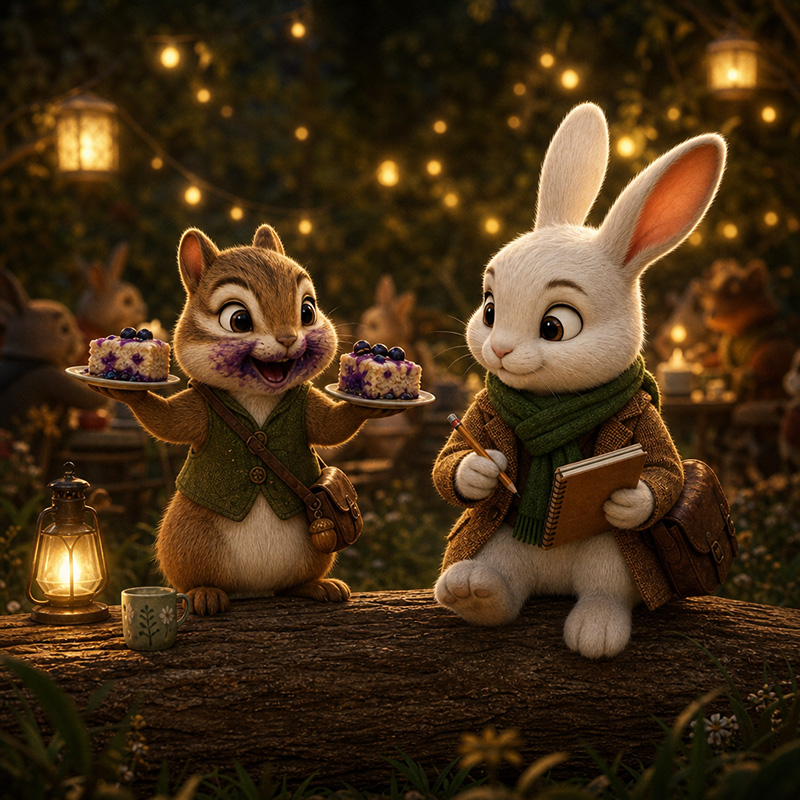
Rupert laughed, took the offered slice, and leaned back on his log. Above them, the real midnight-blue sky stretched wide and endless over Bramblewood Hollow, full of stars—exactly the same shade as Mrs. Pemberlyn Quill’s prize blueberries.
Rupert Hopscotch and Thistle T. Nutwhistle will return.
Friends of the Hutch
This spot is reserved for a hand-picked sponsor—a maker, shop, or small business I’d be proud to share with my readers.
Interested? Get in touch