

Quick answer: What does rabbit body language mean?
A flop onto the side often goes with a relaxed rabbit, and a binky—a jump with a twist and kick—is pure joy. A melted loaf with soft ears means content; a tight, high one with round eyes means cold, tense, or unsure. A soft tooth purr under your hand usually means contentment, but loud grinding or a hunched posture can be a sign of pain or illness, according to the Merck Veterinary Manual—contact your vet right away. The ears, nudges, and chin rubs below fill in the rest of the conversation.
A rabbit tells you everything with the set of an ear, the weight of a body flopping onto its side with a soft thud, the sudden, joyful kick in mid-air that leaves a little dent in the rug and a scattering of hay. Once you learn to read that language, the house feels different. That low, buttery grinding under your fingertips when you stroke a forehead—a tooth purr you feel more than hear—means something deep. That tight, tucked loaf in the corner, eyes wide and unblinking, means something else entirely.
The Happy List—Relaxed Moments
These are lovely signs to notice. Read each one alongside the rest of your rabbit’s behavior.
The Flop
The famous side-flop, sometimes called the dead-bunny flop because it looks so dramatic it scares new owners. One minute upright, the next a soft thud as hip meets floor, back legs stretched long, head tipped, eyes gone soft. It can look like a faint.
That soft side-flop often goes with relaxation. Researchers at the University of Bristol’s veterinary school, who built a pain scale for rabbits, include lying on a flank among relaxed postures. Their scale considers several signs together; a flop alone cannot rule out pain or illness.
If a flop happens near you, enjoy that soft little thud. It often goes with a rabbit at ease.
The Loaf
Two loaves live in one shape, and the difference matters.
Tight loaf: Paws tucked hard underneath, body high and compact like a little bread loaf perched, not settled. Ears tight and upright, eyes round and unblinking, nose twitching fast. The rabbit is conserving heat or holding itself in. It might be a little cold, or unsure about a sound, or just not ready to melt yet.
Relaxed loaf: Paws melted under until invisible, chin resting on the floor or tucked into chest fur, ears soft out to the side—sometimes called airplane ears when relaxed—breathing slow and warm. You can see the sides rise gently. The eyes go narrow, half-closed, buttery. If a loaf leans its warm weight against a foot, that is chosen closeness. The warmth of a loaf against an ankle on a cool evening is one of the quietest kinds of companionship.
How to tell? Look at ear set and eye softness, not just the paws. Tight ears + round eyes = watchful. Soft ears + soft eyes = content.
Tooth Purring
Soft, quiet tooth grinding is usually the sound of a content rabbit. You hear it when the room is quiet, a faint, rhythmic vibration under the hand while stroking the forehead between the eyes. Like a cat’s purr, only felt through bone. Researchers at the University of Melbourne’s veterinary school, reviewing the science on rabbit welfare, list tooth purring as a good sign, heard in content or sleeping rabbits. They add one caution: a rabbit in severe pain can make a similar sound. So the purr means the most when the rest of the body agrees.
There is an important companion note. Loud, crunchy grinding is different. The Merck Veterinary Manual notes that other signs of pain or illness in rabbits include grinding teeth and sitting in a hunched posture. Rabbits often hide illness, Merck adds, so quick veterinary care matters.
Rule of thumb: soft purr with half-closed eyes and a body that melts into the hand = contentment. Loud, harsh grind with hunched body, pressed belly, or not eating = pain.
The Joy Explosion—Binkies Deserve Their Own Section
If the flop is a quiet moment of ease, the binky is joy that cannot be contained.
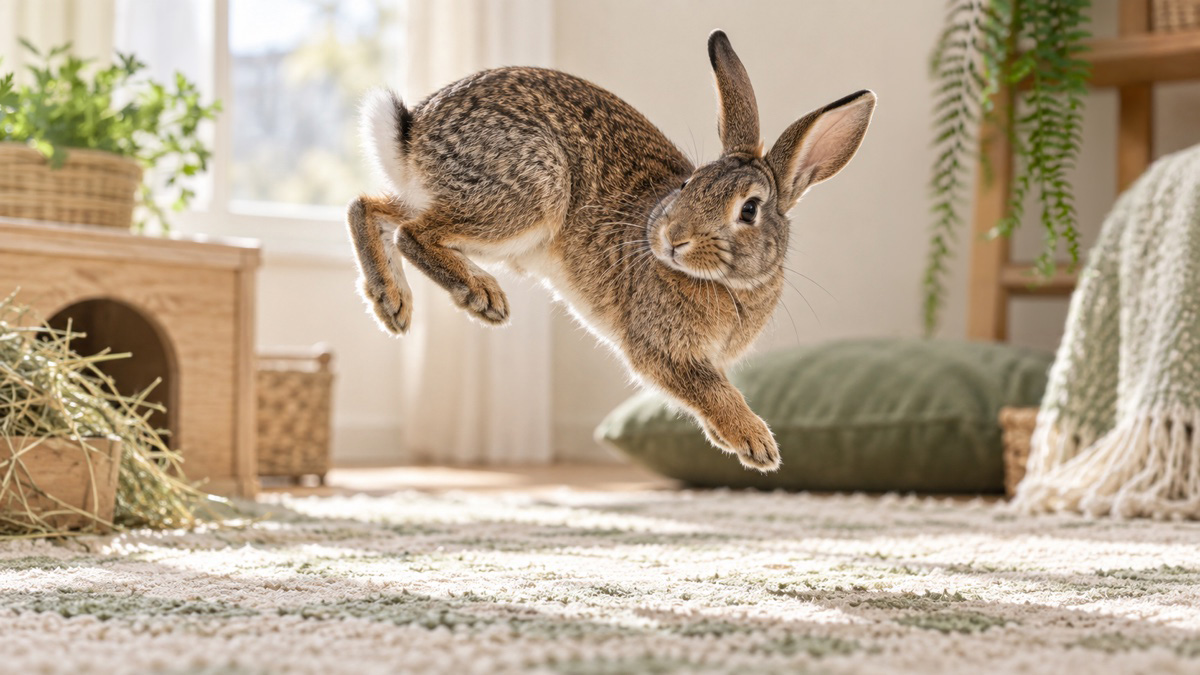
A binky is a jump straight up with a twist, a kick, a head flick, sometimes all at once. No reason. No destination. The rabbit just has to get a little air under its feet.
Baby binkies are small and frequent—popcorn hops every few steps, ears wobbling. Adult binkies are big and rare and better. A full-grown rabbit getting two feet of air, twisting mid-flight, landing slightly sideways in a puff of hay, then doing it again because once was not enough.
Zoomies and the “bunny 500” live right next to binkies. Fast laps around a room or around feet, low to the ground, ears back, taking corners tight enough that the rug ruffles. Why after litter cleaning or fresh hay? The space smells new again. A clean box, a fluffed pile of fragrant timothy—the room is re-written and there’s cause for celebration.
The soft thunder of paws on carpet, hay flying, a little dent left in the rug where a foot landed hard after the last twist.
“I’m Curious, I’m Talking to You”
Rabbits talk all day. Once the happy list is familiar, this is the everyday conversation.
Periscoping: Standing tall on hind legs, front paws tucked or paddling slightly for balance, to see over the edge of something. Curiosity, not begging. “What is that?” A new bag, a sound at the counter, the shape of you coming around a corner.
Nudging: Two meanings, same nose.
Gentle nudge under a hand or chin = “more please.” The nose slides under, lifts lightly. Keep petting.
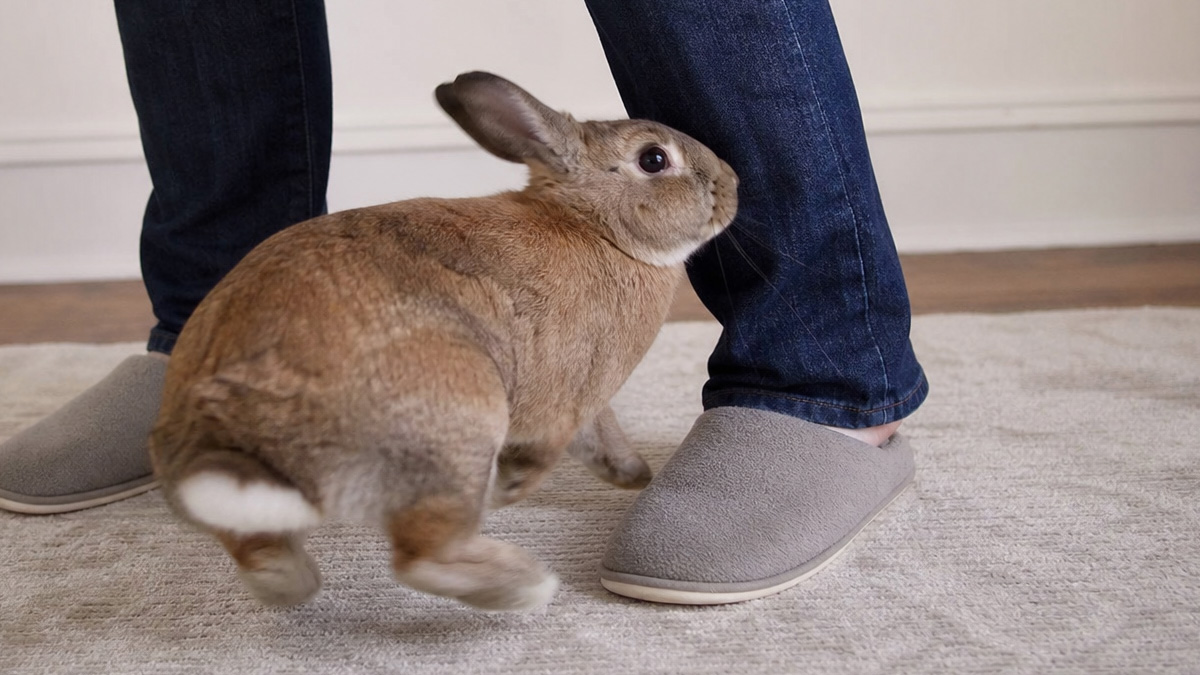
Firm push against a leg, foot, or knee = “move, you’re in my way.” No anger in it, just traffic direction. Step aside.
Chinning: Rubbing chin on everything to mark with scent glands—chair legs, shoes, toys, door frames, and including you. Rabbits have scent glands under the chin, and chinning leaves a quiet claim. You are now property. A compliment of the highest order.
Grooming You / Circling Feet + Honking: Licking hands, arms, or forehead = trust. Tiny licks, sometimes a soft nibble that is barbering, not biting. Circling feet with soft oinks or honks = hormonal affection. Intact rabbits do it more, but neutered rabbits keep a sweet version too. Fast, tight circles around ankles, tail up, making little honking sounds. That is a love letter in rabbit.
Ears, Eyes, Nose: Ears work like radar dishes. More of a rabbit’s mood lives in ear position than almost anywhere else.
- Upright and forward = interested, tracking something.
- Airplane ears to the side = relaxed, or mildly annoyed if paired with a foot flick. Context tells which.
- One up, one down = half-listening, deciding between two sounds, or in that pleasant in-between where listening and loafing overlap.
Nose: fast twitch = exploring, taking in new information. Slow twitch = calm. When a nose stops entirely for a long moment, the rabbit is holding very still to listen.
Eyes: soft half-closed with no white showing can suggest ease. Wide with white rim visible, body low = worried, trying to see more. Rabbits can sleep with eyes open, so open eyes alone do not mean awake or afraid.
“I’m Not Okay”
This section is not meant to scare. It is meant to make help come sooner, with less guessing.
Freezing: Statue-still, breath held, ears tight, eyes wide. The rabbit becomes stone. This is fear, not calm. What to do: look away—direct stare feels like predation—make yourself smaller, lower to the floor, reduce noise and light, give an easy exit path to a hiding box. Let the rabbit unfreeze on its own time.
Thumping: A single hard thump of a hind foot that you feel through floorboards as much as hear. Most often it’s an alarm: “I heard something worrying.” LafeberVet, a veterinary teaching resource, notes that most rabbits thump the ground with their hind feet when they sense danger. Sometimes it’s part of a “back off” warning, along with flattened ears, a raised tail, and a stiff, upright stance. The full guide is Why Do Rabbits Thump?
Tail Up, Ears Flat Back, Boxing, Growling: A “leave me alone” warning. LafeberVet describes the posture: ears flattened, tail stretched up and out, nose or chin thrust forward, and a stiff, upright stance. If the warning is ignored, a rabbit may thump, circle, box, lunge, growl, or nip. Back away, give space and a hide, and don’t chase the rabbit, pick it up, or reach toward its face. LafeberVet names pain or illness as a very important cause of aggression in rabbits and advises having an aggressive rabbit checked by an experienced small mammal veterinarian.
Biting and Nipping: A bite usually means earlier warnings were missed. LafeberVet lists pain or illness, territory, learned behavior, and past rough handling among the reasons rabbits bite people. It also notes that aggression, territoriality, and circling are common signs of sexual maturity, and that spaying or neutering can help, though it won’t erase aggressive behavior completely. Because pain is such an important cause, the first step is a visit to your veterinarian, who can also talk with you about spaying or neutering.
Hunched, Pressed Low, Not Moving, Not Eating: Pain posture. Hunched like a tight ball, belly pressed to the ground, fur maybe fluffed, eyes squinted or dull, refusing hay, fewer or no droppings. The Merck Veterinary Manual lists grinding teeth and a hunched posture as signs of pain or illness and advises contacting your veterinarian for appetite loss or diarrhea. The University of Illinois also flags reduced or abnormal droppings. If you see these changes, contact your veterinarian.
If a rabbit who usually loafs beside you now tucks tight in a corner and will not eat, that is not moodiness. It is a reason to contact your vet right away.
Every Rabbit Has a Dialect
Personality lives here.
Some rabbits are chinners—everything gets chinned, including a hand, twice for emphasis. Some are nudgers, always underhand for more pets. Some never binky big but loaf beside a leg for hours, warm and steady, sharing breath. All affection. Just different accents.
For a week, notice: favorite way to ask for pets, the sound made when happy, where the ears go when relaxed, whether zoomies happen after cleaning or after fresh hay. That notebook becomes a love letter, not a log.
The house changes when the language is known. The cool floor under knees during morning hay, the sweet dust of timothy in afternoon light, the low tooth purr felt more than heard, the soft thud of a flop that can say, without a single word, I feel at ease here.
FAQ
What does it mean when my rabbit flops over?
A sideways flop with legs stretched out often goes with a rabbit at ease. It is called the dead-bunny flop because it looks so dramatic. Enjoy the soft little thud, but read it alongside the rest of your rabbit’s behavior; posture alone cannot rule out illness.
Why does my rabbit binky?
Binkying—jumping straight up with a twist, kick, or head flick—is pure joy and excitement. Baby rabbits do small, frequent popcorn binkies; adults do bigger, rarer ones. You will often see them after a clean litter box, fresh hay, or during free-roam time at dawn and dusk.
Why does my rabbit nudge me?
Two reasons. A gentle nudge under your hand = “more pets please.” A firmer push against your leg or foot = “you are in my way, please move.” Both are normal communication. If nudging is paired with circling feet and soft honking, that is hormonal affection.
Sources
Health and behavior guidance on this page comes from the veterinary and university sources listed below, checked September 2026.
- 1. Benato L, Murrell J, Knowles TG, Rooney NJ (School of Veterinary Sciences, University of Bristol)—“Development of the Bristol Rabbit Pain Scale (BRPS): A multidimensional composite pain scale specific to rabbits (Oryctolagus cuniculus)”, PLOS ONE 16(6), 2021, peer-reviewed Verbatim (Table 6, posture, score 0): “The rabbit is resting in a relaxed and comfortable posture e.g. lying on a flank or on its front with its hind legs to the side, or is moving freely.” Supports: lying on one side as one relaxed posture in a scale that considers several signs together, not as proof that pain is absent. Checked September 18, 2026.
- 2. UC Davis School of Veterinary Medicine—Rabbit Care Verbatim: “Because rabbits are a ‘prey’ species, they seek hiding places when frightened, and therefore should have a ‘hiding box’ in the cage and outside the cage.” Supports: rabbits as prey animals who hide when frightened; the need for hiding boxes. Checked September 18, 2026.
- 3. Merck Veterinary Manual—Illness of Rabbits (Laurie Hess, DVM, DABVP; updated July 2026) + Recognizing and Assessing Pain in Animals (Nick Roman, DVM, MPH; updated September 2025) Verbatim: “Other signs of pain or illness include grinding teeth and sitting in a hunched posture. Rabbits often hide illness, so quick veterinary care matters.”; its Signs of Illness list includes “Loss of appetite and weight” and “Diarrhea or no droppings for more than 12 hours,” followed by “If any of these symptoms occur, contact your vet right away.”; and “Prey animals often hide their pain, which makes it even harder to notice.” Supports: grinding teeth and a hunched posture as signs of pain or illness; rabbits hiding illness and pain; the signs that call for contacting a vet right away. Checked September 18, 2026; Illness of Rabbits rechecked September 23, 2026.
- 4. LafeberVet—“Why Does My Rabbit…? House Rabbit Behavior” and “Aggression in Rabbits” (Christal Pollock, DVM, DABVP) Verbatim (Aggression in Rabbits handout): “Posture can be a warning signs that a bunny is in a ‘bad mood’: Flattened ears; Tail stretched up and out; Thrust nose or chin forward; Strained, upright stance. If this posture is ignored, then the rabbit may thump its feet or sniff agitatedly. He may circle, chase, box or lunge at, or even jaw snap at the source of their displeasure.” and “DO have your aggressive rabbit evaluated by an experienced small mammal veterinarian. Pain or illness is a very important cause of aggression in the rabbit.” Also: “when a rabbit actually bites or kicks a person, this usually means the human has missed a number of nonverbal cues”; its list of why rabbits bite people: “Pain or illness,” “Territorial aggression,” “Learned behavior, improper socialization,” “Previous trauma creating aversive behavior”; “Although neutering can reduce an animal’s defense of their territory, neutering will not completely eliminate aggressive behavior.”; and “Aggression, territoriality, and circling are common signs of sexual maturity in the rabbit, so having your house rabbit spayed or castrated will significantly improve their pet quality.” Supports: most rabbits thump the ground with their hind feet as a warning when they sense danger; the “leave me alone” warning posture and what follows if it is ignored; pain or illness as a cause of aggression and the advice to see a veterinarian; the biting-and-nipping note, including spaying or neutering. Checked September 18, 2026; aggression handout rechecked September 23, 2026. Why Does My Rabbit…? · Aggression in Rabbits
- 5. Cohen S, Ho C (Melbourne Veterinary School, Animal Welfare Science Centre, University of Melbourne; University of Sydney)—“Review of Rat (Rattus norvegicus), Mouse (Mus musculus), Guinea Pig (Cavia porcellus), and Rabbit (Oryctolagus cuniculus) Indicators for Welfare Assessment”, Animals 13(13): 2167, 2023, peer-reviewed systematic review Verbatim: “tooth purring or tooth chattering, which can be heard in content or sleeping rabbits but should not be confused with loud tooth grinding (bruxism), can also be heard in rabbits suffering from severe pain or discomfort.” Its welfare-indicator table lists “Tooth purring” or “teeth chattering” as positive (“Different from tooth grinding (bruxism)”) and “Laying down or ‘flopped’ on their side” as positive or neutral. Supports: tooth purring as a usual sign of contentment, the severe-pain caution, and the flop as a relaxed, positive sign alongside the Bristol pain scale. Checked September 18, 2026.
- University of Illinois College of Veterinary Medicine—Rabbit GI Stasis. Michelle C. Borsdorf, DVM, DACZM; June 4, 2024. Exact excerpts: “reduced appetite, reduced fecal output, abdominal discomfort, and lethargy” and “Early intervention is recommended.” Supports the illness caution about changes in eating and droppings. Checked September 28, 2026. Source link.
- Pigarev IN, Fedorov GO, Levichkina EV, Marimon JM, Pigareva ML, Almirall H—“Visually triggered K-complexes: a study in New Zealand rabbits”, Experimental Brain Research 210:131–142, 2011, peer-reviewed The abstract reports that New Zealand rabbits can sleep with their eyes open; this supports the open-eye sleep observation, not any conclusion about a visible film or an individual rabbit’s health. Checked September 28, 2026.
Found this helpful? The kindest thing you can do is leave a tip or share it with another rabbit person—every guide here stays free, always.
Get rabbit care tips
Join the Hutch list—I write when there’s something worth hopping over for, not every other Tuesday.