

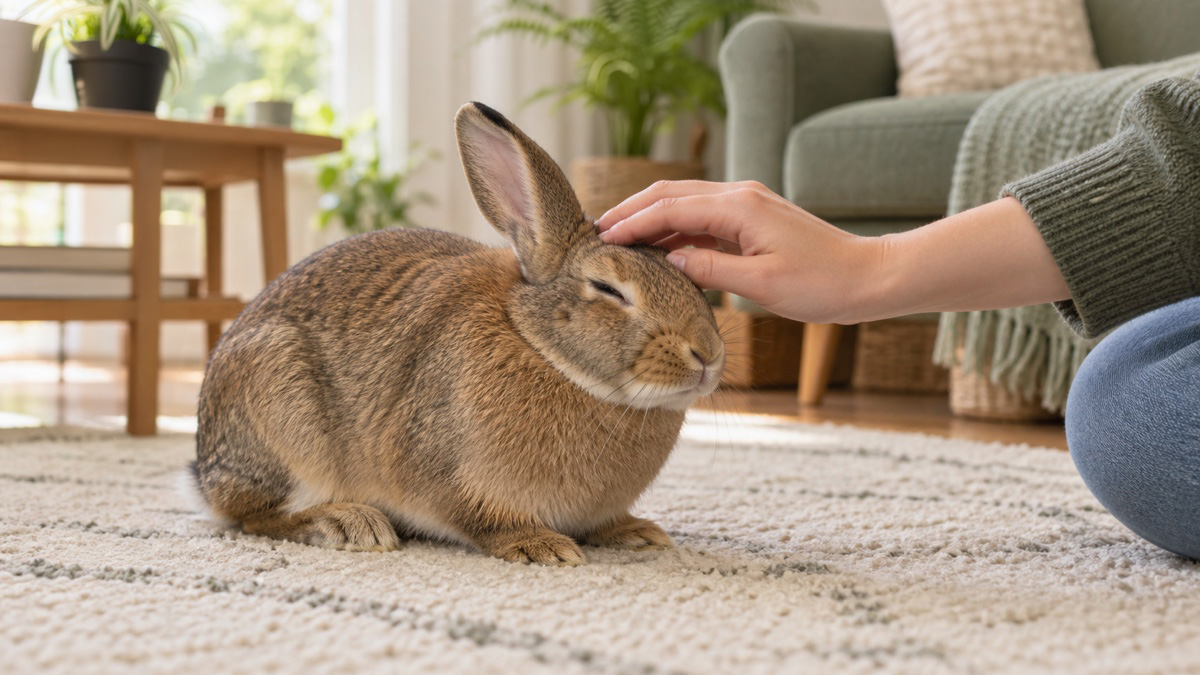
Quick answer: Where do rabbits like to be pet?
Rabbits like to be petted on the forehead between the eyes, on the cheeks, and behind the ears—the same places they groom each other. Use long, slow strokes instead of patting, approach from the side rather than above, and let the rabbit decide when to stay and when to leave. Most rabbits do not enjoy belly, feet, tail, or underside touches. Begin with the forehead, and let your rabbit show you the rest.
That’s the short answer. The longer answer matters too. A rabbit’s world is felt through whiskers and the fine fur of the forehead, through the soft thrum of a tooth purr felt under fingertips more than heard. Pet in the right places and the whole body softens, eyes half-closed, breath slow. Pet in the wrong places and the whole body tenses. Learning the difference changes everything.
The Safe Zones
Start where rabbits wash each other. The very best starting place is the forehead, right between the eyes. A slow, flat hand there is familiar—it says grooming, not grabbing.
From there, many rabbits melt for two other spots: the rounded cheeks and the soft, warm skin just behind the ears. The fur here is velvet-thick, and if you move close you may catch the faint, sweet smell of hay that lives on the coat. The top of the head is often loved too, especially with one long stroke that follows the fur, from the forehead back between the ears, repeated slowly.
Think stroke, not pat. Rabbits feel a steady glide as calming and a quick pat as startling. Keep the pressure light, the rhythm even, and let your fingertips stay in contact.
Every rabbit edits the map a little. Some adore having the base of the ears rubbed between thumb and finger. Some duck away from any ear touch. If the rabbit leans in and lowers the head, keep going. If the head lifts or turns away, that is a boundary. The University of California Agriculture and Natural Resources safe handling guide recommends the same starting point: gently petting the top of the head or stroking the back.
The No-Go Zones—And Why
Rabbits are prey animals, wired to flinch at a shadow from above and to resist anything that feels like capture. That single fact explains every spot they hate being touched.
Belly, feet, tail, and the whole underside are what a predator would grab. Even a deeply bonded rabbit may kick, scramble, or panic if touched there. It is not rudeness—it is wiring.
Chin and under the chin is often misunderstood. People reach there because dogs and cats like it. Many rabbits do not. A few tolerate it, but most tense or pull back. Watch, do not assume.
Behind and over the rump is another predator-grab zone. A hand sweeping from behind toward the tail feels like being caught from above and behind at once.
A steady rule to carry with you: if a rabbit has to brace to allow it, it is not affection. That is tolerance. Real affection looks soft—weight settles, breath slows, eyes go half-moon.
How to Approach So It Feels Safe
Floor level is petting level. Get low, knees on the rug or floor, body turned slightly sideways. A hand arriving from above reads as hawk shadow. A hand arriving from the side reads as another rabbit coming to groom.
Rabbits have a blind spot right in front of the nose. They see well to the sides, but not dead center up close. Offer your hand slightly to the side of the face, low and still, and let the nose do the first hello—a twitch, a sniff, whiskers brushing your knuckle.
Use your voice before your hand. A soft word before touch lets presence have sound before contact. LafeberVet, a veterinary teaching resource, takes the same approach: greet a rabbit with a soft, calm voice, and give casual attention at the rabbit’s level, on the floor.
Then try the consent test. One long, slow stroke on the forehead. Pause, hand still just off the fur.
Does the rabbit nudge forward, lower the head, lean in, or close its eyes a little? That is a yes.
Does it hop away, flick back feet, thump, or freeze with eyes wide? That is a complete sentence. Let it be finished. The same University of California guide puts it plainly: if a rabbit moves away, leave it alone and let the rabbit come back on its own terms. Never chase a rabbit—it will think it is being hunted.
Reading the Answer
A yes looks like this: Tooth purring—that soft, buttery grinding, quiet and rhythmic, felt more than heard under your fingertips. Eyes soft and half-closed. The body loosening into a loaf that sinks against your hand or the floor. A flop nearby, with a soft thud. Nudging your hand for more. Little licks. Staying close even when you stop.
A no looks like this: Ears flat back with a tense body. Freezing with wide eyes and a white rim showing. Grunting. Boxing with front paws. Hopping away and flicking back feet. A thump that vibrates through the floorboards.
One critical distinction, because two sounds use the same teeth:
- Tooth purr = usually contentment. Soft, quiet, steady, felt under your fingers during forehead strokes. Often paired with half-closed eyes and a settled loaf. Researchers at the University of Melbourne note one caution: a rabbit in severe pain can make a similar sound, so the purr means the most when the rest of the body agrees.
- Tooth grinding = pain. Loud, harsh, crunchy grinding you can hear from a distance. Often paired with a hunched, pressed-low posture and not eating.
The Merck Veterinary Manual lists grinding teeth and a hunched posture as signs of pain or illness, and notes that rabbits often hide illness, so quick veterinary care matters. Loud grinding is not a petting preference. If you hear it, especially with a hunched body, a smaller appetite, or fewer droppings, contact your vet right away.
Why Petting Is Not Picking Up
Most rabbits enjoy petting long before they tolerate being held. Petting happens at their level, feet solid on the ground, free to leave. Picking up is restraint, and for a prey animal, restraint feels like capture.
Petting builds the trust account that handling later draws from. One calm minute of forehead strokes after dinner, then another tomorrow, teaches that hands bring comfort, not lift-off. When that account is full, the brief holds needed for nail trims or carrier trips are easier.
When a rabbit does need to be lifted, the Merck Veterinary Manual and the University of California safe handling guide describe the same basic hold: one hand under the chest, the other under the hindquarters and back legs, with the rabbit held gently but firmly against your body. That support protects the spine. Never lift a rabbit by the ears. LafeberVet suggests asking your veterinary team to show you how to hold your rabbit safely, because a rabbit that struggles or kicks while being held can break its back or a leg.
For the slow, step-by-step way that account gets built, see How to Bond With Your Rabbit and Earn Their Trust.
With Children
Children and rabbits can be wonderful together when the floor is the plan.
Have the child sit on the floor, legs still, hands in lap. Let the rabbit come—no walking after the rabbit to pet it. The rule is simple: rabbit approaches person, not the other way around.
One finger on the forehead at first. Adult hand gently over child’s hand, guiding a single, slow stroke between the eyes. No reaching over the head, no belly rubs, no chasing paws.
Best time is after a meal, when the rabbit is already loafing, body low and eyes soft. Not during zoomies, not mid-binky, not mid-explore.
When the rabbit stays, that one finger can become a hand. When the rabbit leaves—even if it flicks feet on the way out—let it leave. Coming back on their own is the part children remember most.
FAQ
Where do rabbits like to be pet the most?
On the forehead between the eyes, on the cheeks, and behind the ears. Use long, slow strokes and pause to see if the rabbit asks for more.
Why does my rabbit hate being pet under the chin?
Under-chin touch comes from below a rabbit’s line of sight and can feel restraining. Most rabbits prefer the forehead and cheeks. Let the rabbit’s response guide you.
How do I know if my rabbit likes being pet?
Your rabbit will tell you. A yes looks soft: half-closed eyes, a body that leans into your hand, a gentle tooth purr you feel more than hear, a nudge when you stop, maybe a flop nearby. A no looks tight and quick: ears flat back, a wide-eyed freeze, a grunt, a front-paw swat, or a hop away with a flick of the back feet. Both answers count, and honoring them is how trust grows. One sound is worth telling apart: loud, crunchy grinding is not a purr. The Merck Veterinary Manual lists grinding teeth and a hunched posture among the signs of pain or illness, so if you notice either, contact your vet right away.
Sources
Health and behavior guidance on this page comes from the veterinary and university sources listed below, checked September 2026.
- University of California Agriculture and Natural Resources, Environmental Health and Safety—Safe Care and Handling of Rabbits, Clover Safe Note #1 (August 2006; written for 4-H volunteers and members) Verbatim: “Slowly allow your rabbit to become familiar with you by sitting on the floor and letting the rabbit first explore you.”; “Initially touch the rabbit by gently petting the top of its head or stroking its back.”; “If a rabbit does not respond to your attention or moves away from you, leave it alone. Be patient and let the rabbit interact with you on its terms.”; “Never chase a rabbit for fun. It will think it is being hunted.”; “Carefully pick up your rabbit by sliding one hand under the rabbits haunches (hind legs) while using your other hand to gently hold the rabbit under the chest. This lifting procedure protects the rabbit’s spine while being picked up.”; “Never pick up a rabbit by the ears.” Supports: floor-level first meetings; the top of the head and the back as starting places; leaving a rabbit alone when it moves away; never chasing; the basic lifting hold and never lifting by the ears. Checked September 23, 2026.
- LafeberVet—Aggression in Rabbits, client education handout (Christal Pollock, DVM, DABVP (Avian Practice); April 16, 2013) Verbatim: “Sit down in the same room, ideally at your rabbit’s level—on the floor.” and “DO greet the rabbit with affection and a soft, calm voice.” Also: “Since there may be times that you will need to move a disgruntled bunny, have veterinary staff demonstrate the proper way to safely restrain a rabbit in a towel. When performed incorrectly, toweling can lead to leg and back fractures.” Supports: a soft voice before touch and calm, floor-level attention; asking your veterinary team to demonstrate safe holding. Checked September 23, 2026.
- Merck Veterinary Manual—Providing a Home for a Rabbit (Laurie Hess, DVM, DABVP; full review July 2026) Verbatim: “When lifting a rabbit, always support the hind end and back legs. Hold the rabbit gently but firmly against your body, with one hand under the chest and the other under the back legs. Rabbits have strong back legs and can kick hard enough to injure their spine if they are handled inappropriately. Never pick up a rabbit by the ears.” Supports: the basic lifting hold and never lifting by the ears. Checked September 23, 2026.
- LafeberVet—Rabbit Restraint (Christal Pollock, DVM, DABVP (Avian Practice); December 27, 2010; reviewed by M. Scott Echols, DVM, and Natalie Antinoff, DVM) Verbatim: “Rabbits possess a relatively lightweight, delicate skeleton paired with extremely strong, well-developed back and leg muscles.” and “If improper restraint allows the rabbit to struggle or kick powerfully, they are in danger of breaking their back or a leg.” Supports: the injury risk when a rabbit struggles while being held. Checked September 23, 2026.
- Merck Veterinary Manual—Illness of Rabbits (Laurie Hess, DVM, DABVP; full review July 2026) Verbatim: “Other signs of pain or illness include grinding teeth and sitting in a hunched posture. Rabbits often hide illness, so quick veterinary care matters.”; its Signs of Illness list includes “Loss of appetite and weight” and “Diarrhea or no droppings for more than 12 hours,” followed by “If any of these symptoms occur, contact your vet right away.” Supports: tooth grinding and a hunched posture as signs of pain or illness; rabbits hiding illness; contacting a vet right away. Checked September 23, 2026.
- Cohen S, Ho C (Melbourne Veterinary School, Animal Welfare Science Centre, University of Melbourne; University of Sydney)—“Review of Rat (Rattus norvegicus), Mouse (Mus musculus), Guinea Pig (Cavia porcellus), and Rabbit (Oryctolagus cuniculus) Indicators for Welfare Assessment”, Animals 13(13): 2167, 2023, peer-reviewed systematic review Verbatim: “tooth purring or tooth chattering, which can be heard in content or sleeping rabbits but should not be confused with loud tooth grinding (bruxism), can also be heard in rabbits suffering from severe pain or discomfort.” Supports: tooth purring as a usual sign of contentment, distinct from loud grinding, and the severe-pain caution. Checked September 18, 2026.
Found this helpful? The kindest thing you can do is leave a tip or share it with another rabbit person—every guide here stays free, always.
Get rabbit care tips
Join the Hutch list—I write when there’s something worth hopping over for, not every other Tuesday.