

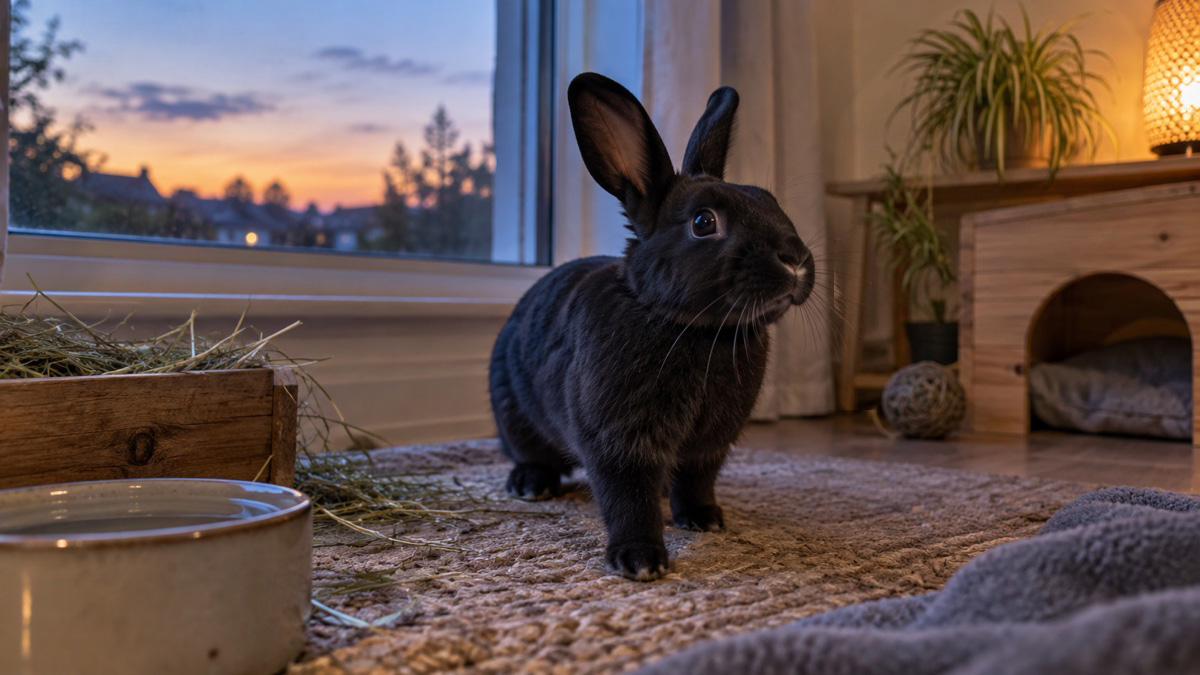
Quick answer: Are rabbits nocturnal?
No, pet rabbits are not nocturnal. In a home, they are crepuscular—most active at dawn and dusk—and they nap in short bursts during the day and the middle of the night. In the wild, that low-light schedule helps them avoid both daytime predators like hawks and nighttime predators like owls. Once you know the twilight pattern, the rest of their schedule makes more sense.
If you have caught your bunny doing zoomies at 10 p.m. and then found the same bunny loafed like a cinnamon roll at noon, you are not alone. This guide explains what crepuscular really means, why your house routine could make your bun seem nocturnal, and how to match your day to your rabbit’s twilight rhythm.
What Crepuscular Means
Crepuscular means active mostly during two specific times of day: the low light just before sunrise (dawn), and the fading light just after sunset (dusk). Rabbits, deer, and some mice are crepuscular. Diurnal—active during the day—describes humans and chipmunks. Nocturnal—active at night—describes owls and raccoons.
Wild rabbits chose those in-between hours for safety. Low light helps them hide from many predators. The University of Florida’s veterinary hospital and the Merck Veterinary Manual both say pet rabbits keep the same basic schedule as wild rabbits. Between those busy hours, they take many short naps.
Watch a house rabbit across a full day. You’ll likely notice the schedule has three shifts: dawn shift for foraging, patrolling, and binkies; midday lull for tucking in, loafing, and dozing; and then the dusk shift when foraging and exploring start again.
Why They Seem Nocturnal
A rabbit has a body clock, just like you do. It tells them when to wake up, when to eat, and when to rest. And that clock takes its cues from the world around it. In a home, that world is you.
Researchers at the University of Ulm in Germany, who spent years studying rabbits’ daily rhythms, found that rabbits have two body clocks working together. One clock is set by light and dark. The other is set by mealtimes. But there’s another factor that can skew things: noise.
Light comes first. In the wild, the fading light at sunset and the first glow of morning tell a rabbit when to wake up and head out to eat. Indoors, those signals get blurry. When the lamps stay bright until 11 p.m., a rabbit’s evening can stretch late into the night, and the dusk zoomies show up at your bedtime instead of at suppertime.
Mealtimes set the clock, too. The same researchers found that rabbits fed at the same time each day started getting busy an hour or more before the food arrived. Over time, much of their day was arranged around that mealtime. So if dinner and fresh hay are served at 9 p.m., your rabbit will learn to be wide awake at 9 p.m.
About that noise. In the same studies, rabbits in a building with daytime noise moved, ate, and drank more while it was noisy. In a quiet building, they did more of that after dark. A busy house shapes the day, and a quiet one leaves the night open.
And some of it is just you, hearing more. At 11 p.m. your house is likely quiet. In the quiet, you hear every hop, every hay rustle, every food bowl clink. But that noise does not always mean your rabbit just woke up. In the stillness, there are just no other sounds covering it up. And, rabbits get up briefly during the night for a snack of hay and to pass droppings. If you catch their quick wake-up, it can seem like they’re going to be up for the whole night shift.
For a rabbit that is dedicated to racing at midnight every night, first look at the day that led up to it. Instead of a behavior problem, it could just be a scheduling issue.
What This Means for Your Schedule
Work with twilight, not against it.
Feed at dawn and dusk. Offer fresh leafy greens and a full top-up of grass hay when your rabbit is naturally hungry—early morning and early evening. That matches their gut and their energy.
Play then, too. Free-roam time, puzzle toys, and gentle training get the best binkies if they happen in the morning and evening. Midday gets the loaf. Let a sleeping loaf lie—waking a rabbit for cuddles at noon is like someone waking you at 3 a.m. for a chat.
Keep nights calm: dim the lights after 10 p.m., tuck the enclosure into a quiet corner, and leave a pile of hay within reach for those brief midnight munches.
When you match the schedule, less chewing on baseboards and more relaxed flopping tend to follow.
How Rabbits Sleep
Rabbits are polyphasic—they take many short naps instead of one long sleep. They can sleep with eyes open, which can look odd.
A rabbit may doze with eyes open. Rabbits also have a third eyelid, called the nictitating membrane. You may see a loaf with ears tipped back and nose still. In deeper sleep, some rabbits close their eyes fully, tuck into a sploot, or flop over on their side.
Resting positions can offer clues:
- Loaf: paws tucked, eyes half-open. Light doze.
- Flop: on the side, legs out. Often a relaxed sleeping posture.
- Sploot: belly down, back legs stretched behind. Relaxed and cool.
An eyes-closed rabbit in a full flop can look wonderfully relaxed.
From the Story Library
If you enjoyed a little twilight science, you might like to know about the Hutch’s next mystery. It begins just as dusk settles in.

FAQ
Are bunnies nocturnal or diurnal?
Neither. In a home, bunnies are crepuscular, most active at dawn and dusk. According to the Merck Veterinary Manual, rabbits are most active early in the morning and in the evening.
Do rabbits sleep at night?
Yes, in short naps. Pet rabbits sleep in bursts during both day and night, with long active periods at twilight.
Do bunnies sleep with eyes open?
Yes. Rabbits can sleep with their eyes open. They also have a third eyelid, called the nictitating membrane. Open eyes alone do not tell you whether a rabbit is awake.
Sources
Health and behavior guidance on this page comes from the veterinary and university sources listed below, checked September 2026.
- University of Florida College of Veterinary Medicine, Small Animal Hospital—How to Care for Your Pet Rabbit. Institutional guidance; no individual author or date shown. Verbatim: “Rabbits are crepuscular animals, which means they are most active during dawn and dusk.” Backs the definition of crepuscular. Checked September 18, 2026. Source link.
- Merck Veterinary Manual—Description and Physical Characteristics of Rabbits. Laurie Hess, DVM, DABVP; reviewed/updated July 2026. Verbatim: “They are most active at dawn and dusk.” Backs dawn-and-dusk activity. Checked September 18, 2026. Source link.
- Merck Veterinary Manual—Selecting a Rabbit. Verbatim: “Because rabbits are most active early in the morning and in the evening, visiting at those times could help you judge personality more accurately.” Backs the most-active-morning-and-evening claim. Source link.
- Merck Veterinary Manual—Nasolacrimal and Lacrimal Apparatus in Animals. Verbatim: “The third eyelid (i.e., nictitating membrane, membrane nictitans) is a fold of conjunctiva that contains a cartilaginous plate…” Backs the definition of the nictitating membrane as the third eyelid. Source link.
- Jilge B (Laboratory Animals Research Unit, University of Ulm)—“The rabbit: a diurnal or a nocturnal animal?” Journal of Experimental Animal Science 34(5–6): 170–183, 1991, peer-reviewed. Verbatim: “rabbits exhibited elevated locomotor activity, hard faeces excretion, food intake and water intake during elevated external animal-house noise” and “When food access was restricted to 4/12 h of the light period, most events of the five behavioral functions were concentrated around the time of restricted food access.” Backs noise and mealtimes shaping a rabbit’s day, and more activity after dark in a quiet building. Abstract checked September 18, 2026. Source link.
- Jilge B (University of Ulm)—“Restricted feeding: a nonphotic zeitgeber in the rabbit.” Physiology & Behavior 51(1): 157–166, 1992, peer-reviewed. Verbatim: “a component of anticipatory activity (AA) was established 1-3 h before food access.” Backs rabbits getting busy an hour or more before a regular mealtime. Abstract checked September 18, 2026. Source link.
- Jilge B, Stähle H (University of Ulm)—“Restricted food access and light-dark: impact of conflicting zeitgebers on circadian rhythms of the rabbit.” American Journal of Physiology 264(4 Pt 2): R708–R715, 1993, peer-reviewed. Verbatim: “two circadian oscillator systems exist in the rabbit, one entrained by light-dark cycles and the other by feeding-fasting cycles.” Backs the two body clocks, one set by light and one by mealtimes. Abstract checked September 18, 2026. Source link.
- Pigarev IN, Fedorov GO, Levichkina EV, Marimon JM, Pigareva ML, Almirall H—“Visually triggered K-complexes: a study in New Zealand rabbits”, Experimental Brain Research 210:131–142, 2011, peer-reviewed The abstract reports that New Zealand rabbits can sleep with their eyes open; this supports the open-eye sleep observation, not any conclusion about a visible film or an individual rabbit’s health. Checked September 28, 2026.
Found this helpful? The kindest thing you can do is leave a tip or share it with another rabbit person—every guide here stays free, always.
Get rabbit care tips
Join the Hutch list—I write when there’s something worth hopping over for, not every other Tuesday.