

Quick answer: What free enrichment can you make for a rabbit?
Start with one easy activity: a handle-free paper bag to explore, a box of loose paper to dig in, or hay with a few of the day’s pellets tucked inside. Use clean, plain materials, remove tape and staples, and watch how your rabbit uses them. If paper or cardboard is being swallowed in large pieces, remove it. There’s no need to make every project at once—follow the fun.
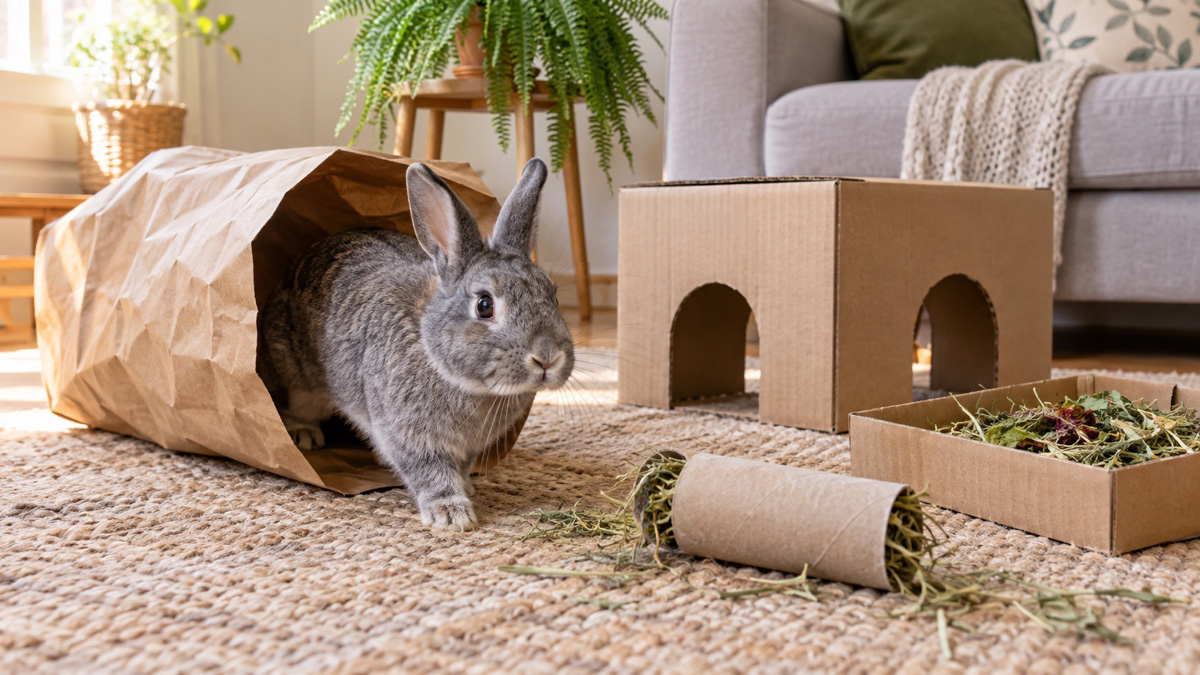
Take a paper grocery bag with its handles removed, cut out the bottom so it becomes a little tunnel, and set it on its side on the floor. Listen. A rustle, a nose appearing at one end, a sudden dash through that makes the paper crinkle and skitter across the boards. No battery, no barcode. The joy is in the rustle, not the receipt.
Enrichment ideas that fit real life, not just a Pinterest board. If the project needs a hot glue gun, special order parts, or twenty minutes you do not have, it will not happen on a Tuesday night. The best enrichment is the kind you can set up while the kettle boils.
Safety First—30-Second Check
Before anything goes on the floor, do the fast scan.
Choose clean, dry, plain paper or cardboard. Remove tape, staples, stickers, plastic windows, and loose labels; skip glossy or coated packaging. Use folds to hold a project together rather than adding craft glue, tape, or string.
Oregon Humane Society recommends paper bags with their handles removed. That includes paper handles: cut off the whole loop, rather than leaving a dangling strip. The point is to leave nothing for a head or foot to catch in, even when the handle looks like a tempting grip for tossing.
The Merck Veterinary Manual lists cardboard boxes and tunnels as enrichment and cardboard among good chewing materials. NC State’s Veterinary Hospital also recommends toilet paper rolls stuffed with hay. For the projects here, choose a clean, plain, uncoated roll without labels or visible glue residue. There’s no need to peel apart the tube’s spiral seam. If a roll doesn’t pass that check, use a folded paper parcel instead.
Stay nearby while your rabbit tries a new item. Most rabbits shred, toss, and rearrange. That ripping sound, the head-flick that sends paper flying, is the point. If a rabbit starts swallowing large pieces of cardboard or paper instead of shredding, lift the item out and offer hay instead. Check toys again before reuse and replace anything wet, soiled, or damaged.
Think in three buckets:
- For shredding and rearranging: plain brown cardboard, uncoated paper bags with handles removed, suitable empty toilet paper rolls, and plain packing paper.
- For gnawing: untreated apple or willow sticks and seagrass mats.
- For eating: the rabbit’s usual grass hay, greens, and small amounts of fresh herbs—see how much herb a rabbit can eat.
Paper and cardboard are play materials, not a replacement for food. Keep the usual hay supply available alongside every activity; a puzzle should be an extra choice, not the only way to get a meal.
Five Free Categories—Simple Projects for Everyday Play
Choose one that suits the materials you have and the things your rabbit already enjoys. The setup gives them something to investigate; what happens next is theirs.
1. Shred & Chew—Paper to Rip and Toss
Some rabbits enjoy the material as much as anything hidden inside it: gripping an edge, pulling it loose, and tossing the result. Start with something light enough to move.
- A crumpled paper ball: Loosely scrunch a sheet of plain packing paper into a ball. Set it on the floor with an edge sticking out to grab. It can be nudged, picked up, or pulled apart; no food filling is needed.
- A small paper bag: Remove the handles, open the bag, and lay it on its side. A rabbit can pull at the rim or flatten and rearrange it. For a bag big enough to climb inside, use the tunnel instructions below.
- A toilet roll hay pop: Put a little hay loosely into a suitable empty roll, with some strands sticking out at both ends. Leave the ends open for the first try so the hay is easy to reach. Later, try folding the edges of one end inward to make a loose flap; the rabbit can pull hay from the other end or roll and nudge the parcel. Don’t pack it tightly or seal it shut.
The sensory part is the whole point—the rip down the side of a bag, the quick toss of the head that showers paper bits across whiskers, the soft rustle as a paper ball rolls away. Keep the shredding check in mind: if large pieces are being swallowed, remove the material.
2. Dig—A Box to Bunch and Burrow In
The University of California’s Agriculture and Natural Resources program describes rabbits as excellent diggers that burrow underground homes called warrens. A dig box gives that pushing, scooping, and rearranging somewhere to happen indoors.
Start with a low cardboard tray or an open storage bin large enough for your rabbit to sit and turn around in. The entrance needs to be easy to step over; if a cardboard box has tall sides, cut a broad opening in one side and smooth the cut edge.
Loosely fill it with torn strips of plain packing paper, then add a handful of the rabbit’s usual hay. Leave room for paws to push the filling aside. Put the box on a steady, nonslip surface in the rabbit’s familiar play area and let them investigate without lifting them into it.
Watch for the front paws scooping, the paper bunching under the chest, and the little shower of scraps behind. Let the rabbit rearrange. Mess is part of enrichment. A washable mat underneath catches some of the scatter; keep its edges out of reach if your rabbit chews fabric. Paper and hay are enough for this starter box—there’s no need for towels or outdoor soil.
3. Forage—Make Dinner a Search
Foraging means searching for food. Instead of putting every pellet in one spot, give your rabbit a few easy finds among familiar hay or paper. Use part of the day’s usual food allowance, rather than adding an extra meal.
- Forage box: Put a loose layer of hay in a low cardboard tray, leaving a clear patch of tray at one end. Place a few of the day’s pellets on that bare patch so they are easy to find. Once your rabbit starts searching, scatter a few among the hay to sniff out. A familiar fresh herb leaf from the usual greens portion can add a bright scent of mint or cilantro.
- Bag search: Lay a small, handle-free paper bag on its side. Put a little hay and a few pellets just inside the opening. For a rabbit who enjoys rummaging, add loosely scrunched paper and tuck some pellets between the pieces. Keep the opening clear.
- Paper parcel: Lay a leaf of the rabbit’s usual greens on a sheet of plain paper. Fold the paper loosely over it, leaving part of the leaf visible for the first try. Once opening it becomes familiar, fold it over a little more. No tight twists, tape, or ties—the nose and teeth do the unwrapping.
Start easy enough that a nudge uncovers something. Nose down, ears forward, slow hops between finds: that’s the activity. If the rabbit walks away, uncover the food or offer it normally and try an easier setup another time. Keep ordinary hay freely available throughout.
4. Tunnel / Hide / Lookout—Places to Explore and Rest
A tunnel is a route through; a hide is a place to tuck away. The Merck Veterinary Manual recommends cardboard boxes and tunnels for rabbits to hide in. Give the rabbit room to enter, turn, and leave without squeezing.
- Paper bag tunnel: Choose a grocery bag roomy enough for your rabbit to pass through. Remove both handles and cut away the closed bottom. Open the bag fully, lay it on its side, and turn back the rims if that helps keep the openings wide. Both ends stay open. If the bag collapses over the entrance, use a box tunnel instead.
- Linked bag tunnels: Prepare two bags that way. Slide an open end of one just inside an open end of the other, keeping the passage clear. Leave the join loose and untaped. If they separate during a dash, the rabbit has simply remodeled the hallway.
- Two-door box or castle: Use a plain box with two broad doorways cut on different sides and the cut edges smoothed. For a castle, set a second box beside it with one doorway facing the first, so the rabbit can move between them. Each box still needs an accessible way out. They don’t have to be fastened together.
- Chair sheet fort: Drape a sheet over two stable chairs, leaving the sides open and the hanging fabric clear of the route through. Put a prepared box or bag tunnel underneath. Cool shade under the sheet, warm light around the edges: a familiar room gets a new little corner. Skip the sheet if your rabbit pulls at or chews fabric.
A lookout is a low raised place to sit and scan the room with ears up. Only use a broad, sturdy box that supports the rabbit’s weight without bowing or shifting, with a grippy surface and an easy hop down onto nonslip flooring. A tunnel at floor level is a complete activity on its own; no tower is needed.
5. Rotation—The Secret to Free
Rotation means putting away some play items and bringing them back later, rather than making a new toy every time. For example, leave out a dig box and paper ball, save a spare bag, then swap the ball for the bag when interest fades. The count and timing are yours to adjust.
Keep favorite resting places, hay, water, and the litter box available. Rotate the optional activities, not the things your rabbit relies on. Store reusable items somewhere clean and dry, and discard anything damp, soiled, or too torn to use again.
A rabbit who ignored a bag on Monday may investigate it on Thursday; another may keep enjoying the same box for weeks. Watch what gets used and change one thing at a time. A new position, a fresh handful of hay, or a doorway facing a different direction can be enough to invite another look.
How You Know It’s Working
Watch body language, not toy destruction. The signs translate directly from what you see here to how enrichment is landing.
- Chinning the new bag or box—rubbing chin to claim it. That is ownership.
- Binkies after exploring—the little sideways kick in the air that means pure delight.
- Flop near the new tunnel—side-flop onto hip, eyes half-closed. Safety in this room, with this new thing in it.
- Loaf inside the bag cave—paws tucked, body warm and heavy, breathing slow. The bag becomes furniture.
If a rabbit ignores a new item, that is not failure. It is preference. Some rabbits are shredders, some are diggers, some are foragers who only care if food is involved. Leave it for a day, then rotate it out.
Enrichment is a problem you let the rabbit solve, not a toy you hand over. When you let the rabbit choose the route, the speed, and the order, you learn how that particular rabbit thinks.
What Not to Use
Some free is not safe.
Wood shavings, especially cedar and pine. The Merck Veterinary Manual says wood shavings shouldn’t be used as rabbit litter because they can cause a digestive tract blockage if swallowed. In its guides to other small pets, Merck adds that cedar and untreated pine shavings contain oils that may be toxic to small animals and can irritate the lungs. If a bag of shavings smells sharp and pleasant to a human nose, that scent is the warning.
Also skip:
- Yoga mats, foam tiles, carpet scraps that invite chewing and swallowing
- String, twine, ribbon, tinsel—loose strands a rabbit could swallow
- Small rubber toys, dog chew toys that can be gnawed into chunks
- Anything with stuffing, squeakers, or glued-on eyes and noses
- Plastic bags, plastic wrap, anything a rabbit could get a head stuck in
If it would be dangerous for a toddler to chew and swallow, assume it is dangerous for a rabbit to chew and swallow. When in doubt, hay wins. A pile of fresh hay to pull, toss, and nest in is always enrichment.
FAQ
Can rabbits eat cardboard?
Rabbits love to shred cardboard because it satisfies natural gnawing and exploring instincts. Shredding a little is expected. Eating large pieces is not. If you see a rabbit eating cardboard rather than just enjoying destroying it, remove it and offer more hay, apple or willow sticks, and seagrass mats instead.
How do I make a dig box that does not make a huge mess?
Use a roomy tray or bin with an entrance your rabbit can step over easily. Higher sides elsewhere can catch some of the scatter. Fill loosely with plain paper and hay, and put a washable mat underneath if your rabbit leaves fabric alone. Let them bunch and rearrange; a little scatter is part of the job.
My rabbit ignores toys. Is something wrong?
Usually no. Preference is normal. Try an easy forage setup with food visible, or swap one optional play item for something different. There’s no required toy count or three-day schedule. If a rabbit suddenly ignores everything, hides, hunches, or stops eating or pooping, that is not an enrichment problem—contact your vet right away. The Merck Veterinary Manual lists appetite loss among signs of illness, and the University of Illinois flags reduced or abnormal droppings.
Are toilet paper rolls safe?
NC State’s Veterinary Hospital recommends toilet paper rolls stuffed with hay as rabbit toys. Choose a clean, plain, uncoated empty roll without labels or visible glue residue; don’t try to peel apart its spiral seam. Stay nearby for the first try. If your rabbit swallows large pieces of the roll, remove it and offer hay without the tube. Thicker cardboard doesn’t solve that problem.
Sources
Veterinary and university sources support the care guidance below; Oregon Humane Society contributes practical activity ideas. New material checked September 30, 2026; earlier source-check dates are listed individually.
- 1. Merck Veterinary Manual—Providing a Home for a Rabbit (Laurie Hess, DVM, DABVP; full review July 2026) Verbatim: “Rabbits need enrichment, like cardboard boxes and tunnels to hide in, and safe toys, like untreated wooden blocks to chew on. Enrichment like this provides activity and helps prevent boredom.”; “Good chewing materials include hay, cardboard, straw, untreated wicker and wood, and pine cones that have been cleaned and dried.”; “Wood shavings, corncob litter, clay litter, and clumping litter should not be used because they can cause a digestive tract blockage if swallowed.” Supports: cardboard boxes, tunnels, and hides as enrichment; cardboard and untreated wood as chewing materials; skipping wood shavings. Checked September 23, 2026.
- 2. Merck Veterinary Manual—Providing a Home for a Gerbil (Thomas M. Donnelly, BVSc, DVP, DACLAM, DABVP (ECM), Cummings School of Veterinary Medicine at Tufts University; Katherine E. Quesenberry, DVM, MPH, DABVP (Avian); full review May 2020) + Providing a Home for a Guinea Pig (Laurie Hess, DVM, DABVP; full review October 2025) Verbatim: “Cedar and untreated pine shavings contain oils that may be toxic to small animals.” and “Avoid cedar and raw pine (they contain oils that can irritate lungs).” Supports: the cedar and pine warning, applied from Merck’s small-pet housing guides. Checked September 23, 2026.
- 3. University of California Agriculture and Natural Resources, Environmental Health and Safety—Safe Care and Handling of Rabbits, Clover Safe Note #1 (August 2006; written for 4-H volunteers and members) Verbatim: “When living in the wild, rabbits spend their time on the ground eating green grasses and leaves and avoiding predators such as hawks and coyotes.” and “Rabbits also are excellent diggers and will burrow out underground homes, called warrens, where they feel protected and prefer to rest and sleep.” Supports: digging as natural behavior; wild rabbits spending their time eating on the ground. Checked September 23, 2026.
- 4. Merck Veterinary Manual—Illness of Rabbits (Laurie Hess, DVM, DABVP; full review July 2026) Verbatim: its Signs of Illness list includes “Loss of appetite and weight” and “Diarrhea or no droppings for more than 12 hours,” followed by “If any of these symptoms occur, contact your vet right away.” Supports: the FAQ line on when a change in behavior is a reason to contact a vet. Checked September 23, 2026.
- University of Illinois College of Veterinary Medicine—Rabbit GI Stasis. Michelle C. Borsdorf, DVM, DACZM; June 4, 2024. Exact excerpts: “reduced appetite, reduced fecal output, abdominal discomfort, and lethargy” and “Early intervention is recommended.” Supports the illness caution about changes in eating and droppings. Checked September 28, 2026. Source link.
- 5. NC State University Veterinary Hospital—Caring for Your Pet Rabbit (institutional guidance; individual author and publication date not shown) Verbatim: “Toilet paper rolls, cereal boxes, and cardboard egg cartons make great toys” and “stuff them with hay!” Supports: hay-filled toilet paper rolls as enrichment. This guidance does not identify tube adhesives or establish the safety of every glue. Checked September 30, 2026.
- 6. Oregon Humane Society—Rabbit Handbook, Enrichment, page 10 (institutional shelter handout; individual author not shown) Verbatim: “paper bags with the handles removed” and “Place your rabbit’s favorite food in brown paper to unwrap!” Supports: handle removal, paper parcels, cardboard hides and tunnels, and paper-filled digging boxes as practical husbandry ideas, not medical claims. Checked September 30, 2026.
- Practical setup notes: The folding instructions, easy entry, loose filling, visible first food finds, checks before reuse, and optional rotation example are RabbitHutch judgment calls built on the cardboard, hay-filled tube, paper-parcel, and digging-box ideas above. They are not tested timing rules or a finding that a particular adhesive is safe.
Found this helpful? The kindest thing you can do is leave a tip or share it with another rabbit person—every guide here stays free, always.
Get rabbit care tips
Join the Hutch list—I write when there’s something worth hopping over for, not every other Tuesday.