

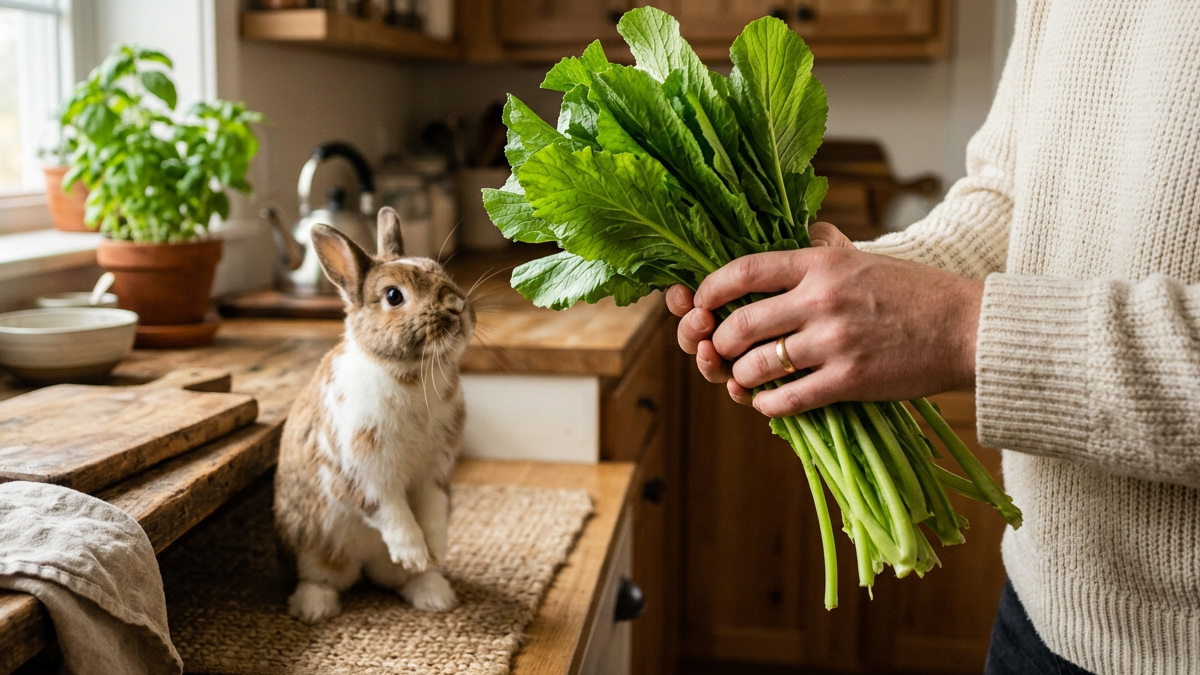
Quick answer: Can rabbits eat mustard greens?
Yes, healthy adult rabbits can have small amounts of mustard greens; the Merck Veterinary Manual recommends limiting them. Count them within the daily mixed salad: this guide follows NC State Veterinary Hospital’s amount of about ½ cup of greens per 2 pounds of body weight. That total includes all greens and herbs, with mustard greens making up a smaller part. A little variety can make a familiar bowl interesting.
How much mustard greens can a rabbit eat?
Think variety, not volume of one green. This guide uses the total mixed-greens amount from NC State Veterinary Hospital: about ½ cup per 2 pounds daily, about 1 cup for a 4-pound rabbit and 2 cups for an 8-pound rabbit. That total includes all greens and herbs together.
Merck recommends limiting mustard greens, while NC State advises smaller rotating additions of greens with more calcium or oxalates. Mix them with familiar leaves rather than filling the bowl with one kind. Published total portions vary, so follow your rabbit-savvy vet’s plan if your rabbit has one. The main greens guide explains the portion guidance.
Adding mustard greens to the mix
Mustard greens bring texture and a little zing. Purdue University College of Veterinary Medicine includes them among its leafy choices and recommends at least three kinds of greens a day once a salad is established. That is guidance for variety, not a cue to introduce three unfamiliar foods at once.
At equal weight, USDA FoodData Central SR Legacy lists mustard greens at 115 mg calcium per 100 g raw (about 3.5 oz), compared with romaine at 33 mg and green leaf lettuce at 36 mg. These figures describe the food, not a rabbit’s portion or calcium absorption. See the main guide’s calcium chart for the full comparison.
Preparing and introducing mustard greens
Keep it fresh and plain. Start with clean hands and a clean board. Rinse leaves under running water, even homegrown, and shake off excess. The FDA notes that washing with soap, detergent, or commercial produce wash is not recommended. Remove damaged areas and discard rotten leaves. Refrigerate perishable greens at 40°F or below.
For a gentle start, Purdue University College of Veterinary Medicine describes establishing a hay-based diet first, then adding greens gradually over weeks. University of Florida Small Animal Hospital also advises gradually increasing new foods while watching for changes. Purdue says a green associated with soft stools may be removed. If you are unsure what a stool change means, ask your rabbit-savvy vet.
When a rabbit needs a different plan
Every rabbit has individual needs. Merck Veterinary Manual notes that these change with age, growth, activity, pregnancy, and nursing. Its general adult feeding guidance includes unlimited grass hay and fresh water. Young rabbits and those on a prescribed diet need their own plan.
Merck explains that urinary stones have several possible contributors, including diet and hydration. A rabbit with previous bladder sludge or stones needs a feeding plan from its rabbit-savvy vet, rather than a change based on one green’s calcium number.
FAQ
Can rabbits eat mustard greens every day?
Merck recommends limiting mustard greens, and NC State favors rotating smaller amounts of greens with more calcium or oxalates. Use them as part of a varied mix rather than the daily base. Neither recommendation gives a fixed number of days per week; your rabbit-savvy vet can tailor the mix.
How should I introduce mustard greens?
Purdue recommends a gradual introduction after a hay-based diet is established. Begin with a small amount and build variety slowly, watching for changes. A green associated with soft stools may be removed, but diarrhea, appetite loss, or a rabbit seeming unwell is a reason to contact your vet right away, as University of Florida and Merck advise.
Can mustard greens replace the other greens?
No. Purdue suggests at least three different greens daily once a salad is established, with more variety being better. Mustard greens work well as one of those, mixed with lower-calcium greens, rather than as the only green.
Sources
Links checked September 17, 2026. These sources support the guidance; this article has not had an independent veterinary review.
- Source: NC State Veterinary Hospital, Caring for Your Pet Rabbit, “Green” and “Veterinary Care” sections. Institutional veterinary guidance; no individual author, credentials, or publication date displayed.
Direct link: Caring for Your Pet Rabbit
Exact excerpt: “We generally recommend feeding about 1⁄2 cup of greens per two pounds bodyweight daily.” Additional excerpt from Veterinary Care: “Signs that your rabbit is sick include a decreased appetite, decreased fecal output” and “please contact your veterinarian right away if you have any indication that your rabbit may be sick.”
Supports: Total mixed-greens amount, calculated examples, and rotation guidance for the mustard article; daily-use FAQ. The veterinary-care section also supports the illness caution on decreased appetite and fecal output. - Source: Merck Veterinary Manual, Diet for Rabbits. Laurie Hess, DVM, DABVP; peer reviewed by Manuals Staff. Reviewed/updated July 2026.
Direct link: Diet for Rabbits
Exact excerpts: “unlimited high-quality grass hay”; “fresh vegetables, about 1 cup per 2 pounds of body weight per day”.
Supports: Adult scope; individual nutritional needs; unlimited grass hay and fresh water. - Source: Purdue University College of Veterinary Medicine, Rabbit Care for Pet Owners, “Diet.” Institutional guidance; no individual author/credentials or publication date displayed.
Direct link: Rabbit Care for Pet Owners
Exact excerpt: “A minimum of three different greens should be fed daily, but the more variety the better.”
Supports: Gradual introduction after an established hay diet; removing a green associated with soft stools; introduction FAQ. Mustard as a listed leafy choice, the three-kind variety suggestion, and replacement FAQ. - Source: University of Florida Small Animal Hospital, College of Veterinary Medicine, How to care for your pet rabbit, “Vegetables” and following diet paragraphs. Institutional veterinary guidance; no individual author/credentials or publication date displayed.
Direct link: How to care for your pet rabbit
Exact excerpts: “a small amount of vegetables (i.e. bell peppers, zucchini)”; “Diarrhea is an emergency in a rabbit”.
Supports: Gradual food changes; diarrhea as an emergency; introduction FAQ and caution box. - Source: Merck Veterinary Manual, Plants and Foods That Are Harmful to Rabbits, table associated with Diet for Rabbits. The table has no separate author/date displayed; the parent article, Diet for Rabbits, is by Laurie Hess, DVM, DABVP (reviewed July 2026).
Direct link: Plants and Foods That Are Harmful to Rabbits
Exact column heading: “Limit Amounts”.
Supports: Qualified yes and limiting mustard greens, including Quick answer and daily-use FAQ; the table supplies no weekly schedule. - Source: Merck Veterinary Manual, Noninfectious Diseases of Rabbits, “Urolithiasis.” Joerg Mayer, DVM, DABVP (ECM), DECZM, DACZM, University of Georgia. Full review July 2021; updated September 2024.
Direct link: Noninfectious Diseases of Rabbits
Exact excerpt: “This often gives the urine a cloudy appearance, which is normal.”
Supports: Urinary stones having several contributors; individualized feeding for rabbits with a urinary history. - Source: Merck Veterinary Manual, Illness of Rabbits, “Signs of Illness in Rabbits.” Laurie Hess, DVM, DABVP; peer reviewed by Manuals Staff. Reviewed/updated July 2026.
Direct link: Illness of Rabbits
Exact excerpt: “Loss of appetite and weight” and “Diarrhea or no droppings for more than 12 hours” (from the Signs of Illness list), followed by “If any of these symptoms occur, contact your vet right away.” Rechecked September 23, 2026.
Supports: Appetite loss and diarrhea as signs of illness in the caution box and introduction FAQ. The quoted 12-hour item is Merck’s source wording, not a suggested waiting period. - Source: U.S. Food and Drug Administration, Selecting and Serving Produce Safely, “Store Properly” and “Prepare Safely.” Institutional food-safety guidance; no individual author/credentials displayed. This is produce-handling guidance, not evidence that a particular plant is safe for rabbits.
Direct link: Selecting and Serving Produce Safely
Exact excerpt: “Washing fruits and vegetables with soap, detergent, or commercial produce wash is not recommended.”
Supports: Preparation: clean hands/board, rinsing, avoiding produce washes, damaged/rotten leaves, and refrigeration. - USDA Agricultural Research Service — FoodData Central, SR Legacy. Institutional food-composition data; no individual clinical author or veterinary credentials apply. Historical reference dataset; values verified September 17, 2026 through original USDA API records.
Calcium values below are milligrams per 100 g raw (about 3.5 oz); the exact nutrient field is “Calcium, Ca,” unit “mg.” Supports: Equal-weight raw mustard calcium comparison with lettuce; composition-versus-portion distinction.
Found this helpful? The kindest thing you can do is leave a tip or share it with another rabbit person—every guide here stays free, always.
Get rabbit care tips
Join the Hutch list—I write when there’s something worth hopping over for, not every other Tuesday.