

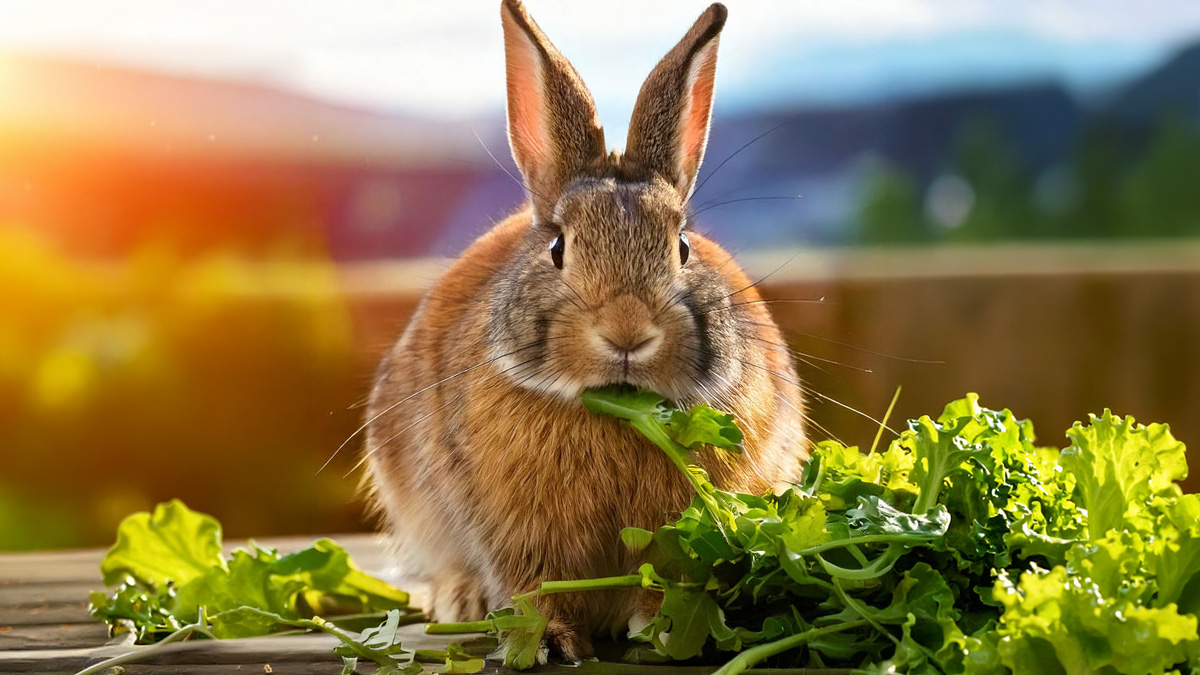
Quick answer: What are the best greens and vegetables for rabbits?
Romaine, red leaf, green leaf, and butterhead lettuce, along with cilantro, are among the lowest-calcium everyday choices for a healthy adult rabbit’s mixed salad, alongside unlimited grass hay and fresh water. This guide follows NC State Veterinary Hospital’s daily greens amount: about ½ cup per 2 pounds of body weight, including all greens and herbs. Published portions vary, so follow an individual plan from your rabbit-savvy vet. The chart below lists twenty-five greens and herbs named in U.S. veterinary guidance, sorted from least to most calcium with what each source advises, so there’s always something new to try.
Good greens for a varied salad
A good salad is a little rustle and a lot of color. The chart below brings together the common salad greens and kitchen herbs named in the U.S. veterinary guidance behind this page, sorted from the least calcium to the most, so you can see the whole picture before you shop. It is not every plant those sources mention: spinach is left out on purpose, as the section on oxalates explains.
Greens at a glance: calcium and what the vets say
Calcium is USDA SR Legacy, per 100 g raw (about 3.5 oz), compared at equal weight. These are food-composition values, not rabbit portions or a safety ranking. Calcium alone does not tell you a green’s oxalate content.
Swipe sideways to see the feeding notes
| Green | Calcium per 100 g raw | What the vets say |
|---|---|---|
| Radicchio | 19 mg | NC State, Purdue, UC Davis: salad green |
| Romaine | 33 mg | NC State, UF, Purdue, UC Davis: salad green |
| Red leaf lettuce | 33 mg | NC State, UC Davis: salad green |
| Butterhead (Boston/Bibb) | 35 mg | NC State: salad green |
| Green leaf lettuce | 36 mg | NC State, UC Davis: salad green |
| Broccoli leaves | 48 mg | Merck: limit amounts. UC Davis: salad green |
| Swiss chard | 51 mg | NC State, Purdue, UC Davis: salad green. Research: high in oxalates, so small amounts |
| Endive | 52 mg | NC State, Purdue, UC Davis: salad green |
| Cilantro | 67 mg | NC State, UF, UC Davis: salad green |
| Bok choy | 105 mg | NC State: salad green |
| Mustard greens | 115 mg | Merck: limit amounts. UF: small amounts |
| Beet greens | 117 mg | Purdue, UC Davis: salad green. Research: oxalates similar to Swiss chard, so small amounts |
| Watercress | 120 mg | NC State: salad green |
| Parsley | 138 mg | UF: small amounts |
| Arugula | 160 mg | NC State, UF: salad green |
| Basil | 177 mg | NC State, Purdue: salad green |
| Dandelion greens | 187 mg | UF: small amounts |
| Turnip greens | 190 mg | Merck: limit amounts |
| Mint (spearmint) | 199 mg | Purdue, UC Davis: salad green |
| Dill | 208 mg | NC State: salad green |
| Collard greens | 232 mg | Merck: limit amounts. UF: small amounts |
| Kale | 254 mg | Merck: limit amounts. UF: small amounts |
| Escarole | Unknown | UC Davis: salad green |
| Carrot tops | Unknown | UF, Purdue, UC Davis: salad green |
| Wheatgrass | Unknown | UF, Purdue, UC Davis: salad green |
“Unknown” means USDA has no SR Legacy record for that green, not that it is low in calcium—which is why those three sit at the foot of the chart. NC State Veterinary Hospital, University of Florida Small Animal Hospital, Purdue University College of Veterinary Medicine, UC Davis School of Veterinary Medicine, and the Merck Veterinary Manual are abbreviated in the last column. Actual produce varies, and these figures do not measure how much calcium a rabbit absorbs. SR Legacy is a historical dataset, closed to updates since 2018. Some figures rest on very few samples—Swiss chard, bok choy, watercress, and turnip greens on a single one each—and some, including arugula, parsley, and dandelion greens, were last updated in 1984. USDA’s own newer record for collards is higher than the one above.
Iceberg lettuce isn’t in the chart for a simple reason: none of the veterinary sources above name it among their salad greens. Its bad reputation online is bigger than the evidence behind it—weight for weight, it is closer to romaine and green leaf on several counts than the internet suggests. See how iceberg compares with other lettuce for the side-by-side numbers.
Romaine stands tall and crisp, red and green leaf lettuce feel tender and ruffled between the fingers, butterhead is soft and almost silky at the heart, and cilantro brings a bright, citrusy perfume. These sit at the low-calcium end of the chart, which makes them easy everyday choices. NC State Veterinary Hospital lists all of them among its salad greens, and University of Florida Small Animal Hospital names romaine and cilantro among suitable greens too.
Arugula deserves a word of its own, because it is often recommended as a daily green. University of Florida lists it among suitable greens, NC State includes it among its salad greens, and it gives a lovely soft peppery bite. But USDA puts it at 160 mg of calcium per 100 g—more than mustard greens or beet greens. NC State’s approach is to build the salad from lower-calcium leaves and rotate the higher ones in smaller amounts; applied to USDA’s figure, that is why this guide places arugula in the rotation rather than the daily base.
Build from familiar leaves with small amounts of other greens. Purdue University College of Veterinary Medicine includes collards, mustard greens, and beet tops among its suggested choices, alongside herbs and other leafy vegetables, and UC Davis School of Veterinary Medicine names escarole, endive, and red leaf lettuce among nutritious foods for herbivorous small mammals. For an established salad, Purdue recommends at least three kinds each day. That is guidance for variety, not a cue to introduce three unfamiliar foods at once.
The Merck Veterinary Manual recommends limiting collard greens, turnip greens, and mustard greens. NC State also advises smaller, rotating amounts of greens with more calcium or oxalates. Beet greens belong in that group: a 2025 study that measured beet leaves and Swiss chard side by side, published in the journal Plants, found similar amounts of oxalic acid in both. Swiss chard belongs in that group too, even though it sits near the low-calcium end of the chart: calcium alone does not tell you a green’s oxalate content, and chard is one of the highest-oxalate leafy greens in the research. All of these can add variety without becoming the whole salad.
Herbs add delight without taking over. A pinch of basil can make the whole bowl smell sweet and warm, dill feels soft and feathery, and mint lifts the mix. A pinch is the right size: at equal weight, USDA puts basil, mint, and dill higher in calcium than arugula, so they belong with the rotating extras rather than the everyday base. Cilantro is the exception, near the low end of the chart. See the herbs guide for herbs that have solid rabbit guidance behind them.
Calcium and oxalates, made simple
Rabbits handle calcium, a mineral, a little differently than people do. According to the Merck Veterinary Manual, they absorb it readily and eliminate substantial amounts through their kidneys. That can make urine look cloudy, which can be normal.
In adult rabbits that are not growing, pregnant, or nursing, a calcium-rich diet over time can contribute to bladder sludge—a buildup of calcium sediment—or urinary stones. Merck also identifies hydration, infection, inherited susceptibility, and metabolic problems as factors in stone formation. The whole diet and the individual rabbit matter, not just one leaf.
NC State’s approach is practical: use greens lower in calcium and oxalates as the everyday base and rotate smaller amounts of higher-calcium or higher-oxalate greens. That keeps the bowl varied and keeps any single green from dominating.
Calcium alone does not tell the whole story. Oxalates—natural compounds found in many greens—matter too, and this is where honesty is worth more than a tidy number. There is no oxalate dataset of the same quality as the calcium one. USDA’s FoodData Central does not include oxalate values, and measurements in the research vary enormously: a 2023 review in the journal Foods puts spinach anywhere from 330 to 2,350 milligrams per 100 grams, depending on variety, soil, season, and laboratory method. Rather than print figures that could mislead, this guide reports what veterinary sources actually advise, and leaves spinach, which shows the widest and highest range of the leafy greens in that review, out of the chart altogether. Swiss chard, which the same review reports at 874 and 1,458 milligrams per 100 grams in two studies, and beet greens, the same plant species and measured similarly, appear in the chart only as small, rotating additions; the beet greens guide explains the evidence.
How much belongs in the bowl?
The bowl is a mix, not a mountain of one green. This guide follows the amount in NC State’s Caring for Your Pet Rabbit handout: about ½ cup of greens per 2 pounds bodyweight daily. That works out to about 1 cup for a 4-pound rabbit and 2 cups for an 8-pound rabbit. This is the total mixed greens allowance, herbs included, not an allowance for each ingredient.
Merck Veterinary Manual gives a different published amount: about 1 cup of fresh vegetables per 2 pounds daily. These are general recommendations, and your rabbit-savvy vet can help choose the right portion for your rabbit. If you already have a vet-approved feeding plan, follow it rather than abruptly changing the diet to match this guide.
Hay stays at the center. Merck recommends unlimited high-quality grass hay, with vegetables as a supplement and fresh water always available. Needs vary with age, growth, activity, breed, pregnancy, and nursing. This guide is for healthy adults; young rabbits and rabbits with health conditions need individual guidance.
A gentle introduction
A new leaf is an invitation, not a test. Start with a hay-based diet that is already steady, then add variety gradually over weeks. Purdue University College of Veterinary Medicine describes that slow build, and University of Florida Small Animal Hospital advises gradually increasing new foods while watching for adverse effects.
Watch the litter box as you build that variety. Purdue notes that a green associated with soft stools may be removed. But soft-looking material is not always diarrhea: University of Florida explains that rabbits also produce cecotropes, the special soft droppings they normally eat. The droppings guide explains how these differ from hard round pellets. If you are unsure about a change, ask your rabbit-savvy vet.
From the crisper to the bowl
Good prep is simple and sensory. Start with clean hands and a clean cutting board. Leaves rustle as they are lifted from the bag, cool and a little damp. Rinse produce under running water, including homegrown greens, and shake off the excess. The FDA notes that washing fruits and vegetables with soap, detergent, or commercial produce wash is not recommended.
Keep it fresh and plain. Following FDA guidance, remove damaged areas, discard rotten produce, and refrigerate perishable greens at 40°F or below. Washing reduces contamination but does not sterilize leaves. A pleasant smell does not prove a food is safe, but simple preparation can be a reassuring part of the daily routine.
What about other vegetables?
Leafy greens are the everyday workhorses, but a little extra color can join the bowl in small amounts. University of Florida Small Animal Hospital mentions a small amount of vegetables such as bell peppers and zucchini as an example of that kind of addition.
For foods to leave out of the bowl, see the foods rabbits must not eat guide. A few familiar choices, offered thoughtfully, are a good place to begin.
FAQ
Can rabbits have greens every day?
Yes, for healthy adult rabbits, a daily mix can be part of the routine when hay is unlimited. NC State Veterinary Hospital gives the daily mixed-greens amount used in this guide, and Merck Veterinary Manual describes unlimited high-quality grass hay as the foundation with fresh water always available. Published amounts vary, so your rabbit-savvy vet can help tailor the portion.
Which of these greens have less calcium?
In this USDA SR Legacy comparison, radicchio, romaine, red leaf, butterhead, and green leaf lettuce sit at the low end, and kale and collard greens at the high end. The chart gives the figures for every green on this page. It compares food composition, not rabbit portions or overall safety; a lower calcium number does not necessarily mean a lower oxalate content.
Can rabbits eat kale or spinach?
University of Florida Small Animal Hospital includes both, with advice to offer only small amounts because of calcium or oxalic acid, and Merck also recommends limiting kale. Kale carries the highest calcium figure in the chart. Spinach is left out of the chart because published oxalate measurements for it vary so widely. Both can be part of a varied mix; neither needs to be the whole bowl.
Can vegetables replace hay?
No. Merck Veterinary Manual recommends unlimited high-quality grass hay, with vegetables as a supplement. Purdue explains that hay supplies important fiber and encourages tooth wear. Greens add variety, but hay remains the everyday foundation.
Sources
Links checked September 22, 2026. These sources support the guidance; this article has not had an independent veterinary review.
- Source: NC State Veterinary Hospital, Caring for Your Pet Rabbit, “Green” and “Veterinary Care” sections. Institutional veterinary guidance; no individual author, credentials, or publication date displayed.
Direct link: Caring for Your Pet Rabbit
Exact excerpts: “We generally recommend feeding about 1⁄2 cup of greens per two pounds bodyweight daily.”; “we recommend feeding greens that are lower in calcium and oxalates as the basis of your pet’s salad and rotating through the higher calcium/oxalate greens in smaller quantities”. Additional excerpt from Veterinary Care: “Signs that your rabbit is sick include a decreased appetite, decreased fecal output” and “please contact your veterinarian right away if you have any indication that your rabbit may be sick.”
Note on its greens table: this handout also carries a calcium/oxalate table whose own footnotes credit nutritiondata.com and lowoxalateinfo.com, with no measurement basis given. Its level words are therefore not reproduced here. What is used is which greens NC State names for the salad, and its base-and-rotate recommendation above.
Supports: Quick answer; the salad greens named in the chart (radicchio, romaine, red leaf, butterhead, green leaf, curly endive, cilantro, bok choy, watercress, arugula, basil, dill, Swiss chard); smaller rotating additions of higher-calcium or higher-oxalate greens; portion and calculated examples; daily-greens FAQ; illness caution on decreased appetite and fecal output. The page’s statements about beet greens’ oxalates rest on the Almeida et al. study below, not on this handout’s rating. - Source: Merck Veterinary Manual, Diet for Rabbits. Laurie Hess, DVM, DABVP; peer reviewed by Manuals Staff. Reviewed/updated July 2026.
Direct link: Diet for Rabbits
Exact excerpts: “unlimited high-quality grass hay”; “fresh vegetables, about 1 cup per 2 pounds of body weight per day”.
Supports: Different published vegetable amount; hay and water; individual needs and adult scope; daily-greens and hay FAQs. - Source: Purdue University College of Veterinary Medicine, Rabbit Care for Pet Owners, “Diet.” Institutional guidance; no individual author/credentials or publication date displayed.
Direct link: Rabbit Care for Pet Owners
Exact excerpt: “A minimum of three different greens should be fed daily, but the more variety the better.”
Also listed: kale, collards, beet tops, carrot tops, parsley, dandelion greens, chicory, mustard greens, romaine lettuce, raspberry leaves, basil, mint, endive, radicchio, wheat grass, and Swiss chard, among its “clean, fresh leafy greens.”
Supports: Leafy choices and variety; the Purdue credits in the chart (radicchio, romaine, Swiss chard, endive, beet greens, basil, mint, carrot tops, wheatgrass); gradual introduction after a hay diet is established; removing an associated green; hay and tooth-wear FAQ. - Source: University of Florida Small Animal Hospital, College of Veterinary Medicine, How to care for your pet rabbit, “Vegetables” and following diet paragraphs. Institutional veterinary guidance; no individual author/credentials or publication date displayed.
Direct link: How to care for your pet rabbit
Exact excerpts: “a small amount of vegetables (i.e. bell peppers, zucchini)”; “Diarrhea is an emergency in a rabbit”.
Supports: Romaine, cilantro, carrot tops, and wheatgrass choices; arugula as a suitable green; small amounts of kale, collards, parsley, mustard greens, and dandelion greens; gradual changes and cecotropes; diarrhea warning; bell pepper and zucchini; kale/spinach FAQ. - Source: Merck Veterinary Manual, Plants and Foods That Are Harmful to Rabbits, table associated with Diet for Rabbits. The table has no separate author/date displayed; the parent article, Diet for Rabbits, is by Laurie Hess, DVM, DABVP (reviewed July 2026).
Direct link: Plants and Foods That Are Harmful to Rabbits
Exact column heading: “Limit Amounts”.
Supports: Limiting collard, turnip, and mustard greens; kale FAQ. - Source: Merck Veterinary Manual, Noninfectious Diseases of Rabbits, “Urolithiasis.” Joerg Mayer, DVM, DABVP (ECM), DECZM, DACZM, University of Georgia. Full review July 2021; updated September 2024.
Direct link: Noninfectious Diseases of Rabbits
Exact excerpt: “This often gives the urine a cloudy appearance, which is normal.”
Supports: Calcium absorption and urinary elimination; normal cloudiness; possible contributors to sludge and urinary stones. - Source: Merck Veterinary Manual, Illness of Rabbits, “Signs of Illness in Rabbits.” Laurie Hess, DVM, DABVP; peer reviewed by Manuals Staff. Reviewed/updated July 2026.
Direct link: Illness of Rabbits
Exact excerpt: “Loss of appetite and weight” and “Diarrhea or no droppings for more than 12 hours” (from the Signs of Illness list), followed by “If any of these symptoms occur, contact your vet right away.” Rechecked September 23, 2026.
Supports: Appetite loss and diarrhea as signs of illness in the caution box. The quoted 12-hour item is Merck’s source wording, not a suggested waiting period. - Source: U.S. Food and Drug Administration, Selecting and Serving Produce Safely, “Store Properly” and “Prepare Safely.” Institutional food-safety guidance; no individual author/credentials displayed. This is produce-handling guidance, not evidence that a particular plant is safe for rabbits.
Direct link: Selecting and Serving Produce Safely
Exact excerpt: “Washing fruits and vegetables with soap, detergent, or commercial produce wash is not recommended.”
Supports: Clean preparation, running-water washing, refrigerated storage, and damaged/rotten produce. - Source: UC Davis School of Veterinary Medicine, Nutrition for Herbivorous Small Mammals, Animal Health Topics. Bylined John Gardiner, April 11, 2019; no clinical author credentials displayed. The page is guidance from the school’s Nutrition Service and Companion Exotic Animal Medicine and Surgery Service, and it covers rabbits, chinchillas, and guinea pigs together rather than rabbits alone.
Direct link: Nutrition for Herbivorous Small Mammals
Exact excerpt: “Listed below are some nutritious foods for you to incorporate into your pet’s diet.”
Supports: Escarole, endive, radicchio, red leaf and green leaf lettuce, romaine, cilantro, mint, carrot tops, wheatgrass, broccoli leaves, Swiss chard, and beet greens as named choices in the chart. Its list is cited and paraphrased, not reproduced; the chart’s order is by calcium, and several foods on the UC Davis list (carrots, radish tops, clover) are deliberately not carried over. - Source: Salgado N, Silva MA, Figueira ME, Costa HS, Albuquerque TG. Oxalate in Foods: Extraction Conditions, Analytical Methods, Occurrence, and Health Implications. Foods 2023;12(17):3201. Peer-reviewed review article. This is food-composition research, not rabbit feeding guidance.
Direct link: Oxalate in Foods (PMC10486698)
Use: Its Table 5 reports spinach at 329.6–2350 mg total oxalate per 100 g and Swiss chard at 874 and 1458.1 mg in two studies, and it attributes such ranges to growth, ripeness, climate, region, soil, harvest time, and analytical method.
Supports: Why no oxalate figures appear in the chart, why spinach is left out of it, and why Swiss chard appears only in small amounts. - Source: Almeida D, Petropoulos SA, da Silveira TFF, et al. Exploring the Biochemical Profile of Beta vulgaris L.: A Comparative Study of Beetroots and Swiss Chard. Plants 2025;14(4):591. Peer-reviewed research article. Food-composition research on human foods, not rabbit feeding guidance.
Direct link: Exploring the Biochemical Profile of Beta vulgaris L. (PMC11859049)
Exact excerpt: “This is especially so for the leaves which recorded higher amounts of oxalic acid than roots in all of the beetroot samples, as well as the leaves of Swiss chard, where amounts similar to beetroot leaves were detected.”
Use: Its Table 1 reports oxalic acid in the leaves of three table-beet cultivars at 2.13, 2.89, and 3.78 g per 100 g dry weight, against 2.37 g for Swiss chard leaves, measured the same way in the same study (three replicates each). These are dry-weight figures from one study and are not converted or compared with the fresh-weight figures above.
Supports: Beet greens as a small, rotating addition; beet greens measuring similarly to Swiss chard for oxalates; the beet greens and Swiss chard rows in the chart. - USDA Agricultural Research Service — FoodData Central, SR Legacy. Institutional food-composition data; no individual clinical author or veterinary credentials apply. Historical reference dataset, closed to updates since its final release in April 2018; values verified September 21, 2026 from USDA’s published food records.
Calcium values below are milligrams per 100 g raw (about 3.5 oz); the exact nutrient field is “Calcium, Ca,” unit “mg.”- Radicchio, raw — FDC 168564: 19 mg.
- Lettuce, cos or romaine, raw — FDC 169247: 33 mg.
- Lettuce, red leaf, raw — FDC 168431: 33 mg.
- Lettuce, butterhead (includes boston and bibb types), raw — FDC 168429: 35 mg.
- Lettuce, green leaf, raw — FDC 169249: 36 mg.
- Broccoli, leaves, raw — FDC 169329: 48 mg.
- Chard, swiss, raw — FDC 169991: 51 mg.
- Endive, raw — FDC 168412: 52 mg.
- Coriander (cilantro) leaves, raw — FDC 169997: 67 mg.
- Cabbage, chinese (pak-choi), raw — FDC 170390: 105 mg.
- Mustard greens, raw — FDC 169256: 115 mg.
- Beet greens, raw — FDC 170375: 117 mg.
- Watercress, raw — FDC 170068: 120 mg.
- Parsley, fresh — FDC 170416: 138 mg.
- Arugula, raw — FDC 169387: 160 mg.
- Basil, fresh — FDC 172232: 177 mg.
- Dandelion greens, raw — FDC 169226: 187 mg.
- Turnip greens, raw — FDC 170061: 190 mg.
- Spearmint, fresh — FDC 173475: 199 mg.
- Dill weed, fresh — FDC 172233: 208 mg.
- Collards, raw — FDC 170406: 232 mg.
- Kale, raw — FDC 168421: 254 mg.
Supports: The calcium column and its limitations; the chart’s ordering; the positions of arugula, basil, mint, and dill; lower-calcium FAQ.
Found this helpful? The kindest thing you can do is leave a tip or share it with another rabbit person—every guide here stays free, always.
Get rabbit care tips
Join the Hutch list—I write when there’s something worth hopping over for, not every other Tuesday.