

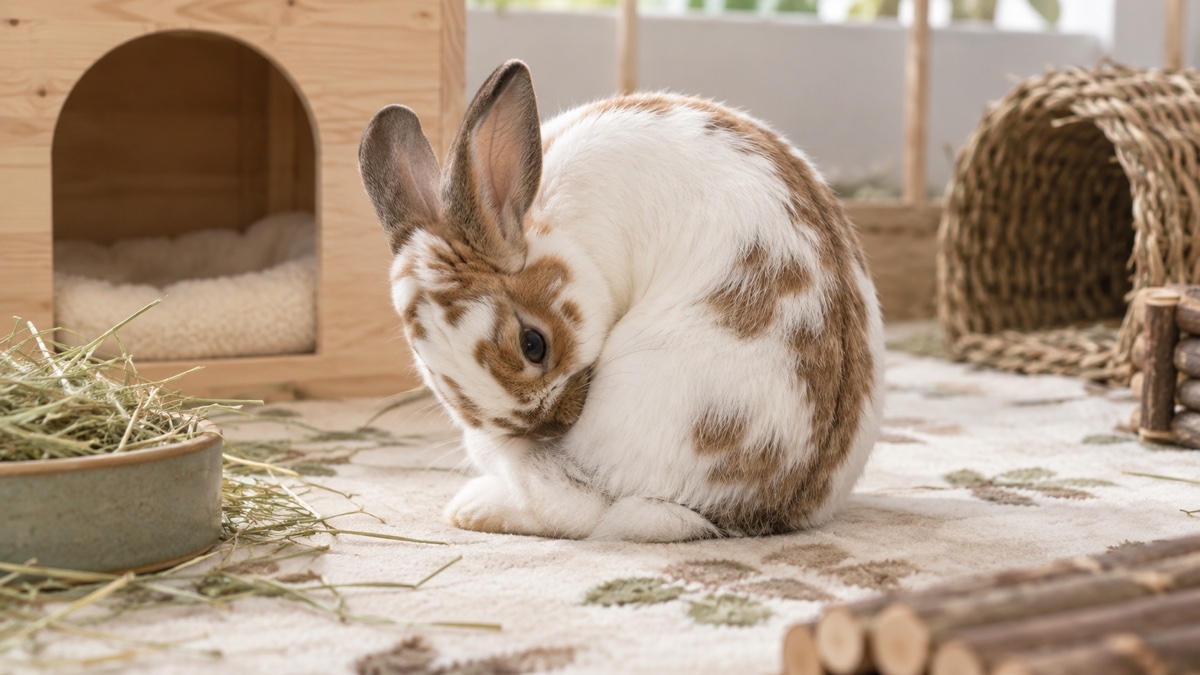
Quick answer: Why do rabbits eat their droppings?
It’s completely normal for a rabbit to eat soft, dark, clustered droppings straight from their bottom. Those droppings are cecotropes, soft and nutrient-rich; the hard, round pellets left in the litter box are the regular waste. Eating cecotropes, called cecotrophy, gives food a second pass: the rabbit absorbs B vitamins and protein made by gut bacteria as they ferment fiber in the cecum, a large pouch in the digestive tract. Most owners never see it happen, since rabbits eat cecotropes directly as they are passed—which is why uneaten ones are worth noticing.
The first time you catch it, it can stop you in your tracks: a rabbit curled into a tidy ball, head tucked low, busy with something underneath. It looks strange. It is also one of the most ordinary, healthy things a rabbit does. This guide explains why, how to tell the two kinds of droppings apart, and the one sign that deserves a closer look.
Two Kinds of Droppings
A rabbit makes two very different products, and only one of them is waste.
Regular fecal pellets. Hard, round, dry, light tan to medium brown, almost no smell, crumbling with a little hay dust. These are the true waste, the pellets a hay-fed rabbit passes all day long and leaves behind—in the litter box and, often, everywhere else.
Cecotropes. Soft, dark, shiny, clustered like blackberries, strong fermented smell, coated with a thin, sticky membrane. According to Manual of Exotic Pet Practice, cecotrophs differ from feces in that they are soft, moist, usually stuck together, and eaten directly from the anus.
VCA Animal Hospitals explains that eating these soft droppings is normal and healthy in rabbits, even though eating droppings may be a problem in other animals. Most rabbits do it overnight, which is why owners rarely see it. VCA notes these pellets are called cecotropes, cecal droppings, nocturnal droppings, or night droppings, and are usually small, soft, pasty, darker, and have a strong fermented or sweet smell.
Picture a dry, round little ball of pressed hay next to a soft, glossy blackberry that has been gently squashed—that is the difference between a fecal pellet and a cecotrope.
Why Cecotropes Are Essential
Rabbits are hindgut fermenters—they ferment fiber in a large cecum rather than a multi-chamber stomach. Hay fiber travels to the cecum, where resident bacteria break it down.
The Merck Veterinary Manual explains that the cecum’s contents are expelled at intervals as soft cecotrophs, which the rabbit eats directly from the anus, and that this material provides protein made by gut bacteria and vitamins, including all the B vitamins a rabbit needs. VCA adds that these pellets are a rich source of nutrients for the rabbit—specifically protein and vitamins B and K.
That is the second pass at work, and Manual of Exotic Pet Practice explains why the mucus coating matters—it protects the volatile fatty acids, vitamins, and amino acids inside from the stomach’s low pH, so those nutrients survive to be absorbed further along the digestive tract.
Two terms worth keeping straight:
- Cecotrophy means eating the soft, nutrient-rich cecotropes. This is the normal digestive behavior described here.
- Coprophagy is the broader term for eating fecal material. It is sometimes used for rabbit cecotrophy, although the two terms aren’t quite equivalent.
Without cecotrophy, a rabbit would miss the B vitamins its own gut bacteria make. The protein matters too, though Merck notes it is a smaller share: the rest of the diet still has to supply most of what a rabbit needs.
Rabbits aren’t alone in this. Pikas, the rabbit’s small mountain cousins, make the same soft droppings and eat them straight from the body. Chinchillas make two kinds of pellets too: one meant to be eaten, and one left behind as waste.
When Not Eating Them Is a Warning
The signal to watch for is uneaten cecotropes left on the fleece or stuck to fur—not the act of eating them, which normally happens out of sight. An occasional stray one is not unusual: veterinarian Susan Brown, writing for Veterinary Partner, describes the normal picture as round, dry droppings with only the occasional formed cecotrope in the litter box.
Why So Much Poop?
A healthy, hay-fed rabbit is a poop factory, and that is a good sign. The Merck Veterinary Manual explains that the large, indigestible fiber in hay keeps the gut moving and leaves the body as those hard, round pellets.
Pellets work like a daily report card. Veterinary Partner’s Susan Brown says plenty of large, round droppings is how you know a rabbit is eating enough hay. If they shrink to half their size or less, drop sharply in number, or become badly misshapen, she advises checking with your veterinarian. If droppings stop, contact your veterinarian rather than waiting for a set number of hours; the University of Illinois lists reduced or abnormal output among presenting signs.
For the feeding side of this story, see the complete hay guide, and for subtler cues, Rabbit Body Language.
FAQ
Is it normal for rabbits to eat their poop?
Yes—when it’s the right kind. Rabbits normally eat cecotropes, the soft, dark, clustered droppings, and VCA Animal Hospitals calls this normal and healthy in rabbits, even though eating droppings may be a problem in other animals. The hard, round pellets are different: they are the regular waste, the ones a healthy rabbit leaves in the litter box.
What are cecotropes?
Cecotropes are soft, dark, nutrient-rich droppings made in the cecum. According to the Merck Veterinary Manual, they carry protein made by gut bacteria and vitamins, including all the B vitamins a rabbit needs. They are coated in mucus and eaten directly from the anus, unlike regular hard pellets.
Should I be worried if my rabbit isn’t eating their cecotropes?
An occasional stray cecotrope is not unusual. Soft, sticky clusters left often, or stuck to the fur, are worth a vet visit. Veterinary Partner says the most common cause is a diet too high in carbohydrates or too low in fiber, and advises a complete veterinary exam first to rule out other causes. If stools turn watery or droppings stop, contact your veterinarian right away; the University of Illinois also flags reduced or abnormal droppings.
Sources
Health and behavior guidance on this page comes from the veterinary and university sources listed below, checked September 2026.
- VCA Animal Hospitals—Health Problems in Rabbits. Verbatim: “Rabbits engage in coprophagy, which means they eat their own feces. While this may be a problem in other animals, it is a normal and healthy behavior in rabbits.” and “They are called cecotropes, cecal droppings, nocturnal droppings, or night droppings, and are usually small, soft, pasty, darker, and have a strong fermented or sweet smell. These pellets serve as a rich source of nutrients for the rabbit, specifically protein and vitamins B and K.” and “Rabbits typically do this overnight, so owners never see it.” Malcolm Weir, DVM, MSc, MPH; Laurie Hess, DVM; Rick Axelson, DVM. Checked September 23, 2026. Source link.
- Merck Veterinary Manual (professional edition)—Nutrition of Rabbits. Joerg Mayer, DVM, DABVP (ECM), DECZM, DACZM; full review July 2021. Verbatim: “At intervals, the cecal contents are expelled as ‘soft feces’ or cecotrophs and consumed by the rabbit directly from the anus. Cecotroph ingestion is highest when rabbits are fed a diet high in nondigestible fiber. This reingested material provides microbial protein, vitamins (including all the B vitamins needed), and small quantities of volatile fatty acids…” and “because amino acids obtained in this manner make only a minor contribution to the rabbits’ protein needs… the diet must supply the additional amino acids.” Also: “Peristaltic action rapidly moves large particles (>0.5 mm), primarily lignocellulose, through the colon and excretes them as hard fecal pellets.” and indigestible fiber is important for “stimulating GI motility… and stimulating appetite and ingestion of cecotrophs.” Backs the nutrient content of cecotropes, the smaller role of their protein, hay fiber keeping the gut moving and forming hard pellets, and fiber encouraging cecotrophy. Checked September 23, 2026. Source link.
- Merck Veterinary Manual—Illness of Rabbits. Laurie Hess, DVM, DABVP; full review July 2026. Verbatim: its Signs of Illness list includes “Diarrhea or no droppings for more than 12 hours,” followed by “If any of these symptoms occur, contact your vet right away.” Backs the when-to-call-your-vet lines. Checked September 23, 2026. Source link.
- Veterinary Partner (VIN)—Intermittent Soft Cecotropes in Rabbits. Susan Brown, DVM; published November 11, 2009. Verbatim: “The soft stools are actually malformed cecotropes that should have been eaten directly from the anus by the rabbit.”; “The most common cause of ISC is an inappropriate diet that is too high in carbohydrates and/or too low in indigestible fiber.”; “During a physical examination, many rabbits with ISS are significantly overweight”; “Prior to treating your rabbit for ISC, it is advisable to have your veterinarian do a complete physical examination”; “A healthy diet for a house rabbit consists of unlimited grass hay as its primary component with additional green foods and limited high fiber/low energy pellets.”; “You will see the normal round, dry waste droppings and only the occasional formed cecotrope in the litter box”; and “If these droppings decrease to half or less in size or greatly decrease in number or become greatly misshapen, then your rabbit is not eating enough and you need to check with your veterinarian.” Backs the hard, round pellets as the regular waste left in the litter box (Quick Answer, Two Kinds of Droppings, and the first FAQ), the left-behind cecotropes box, the report-card paragraph, and the cecotrope FAQ answer. Checked September 23, 2026. Source link.
- LafeberVet—Behavior Essentials: The European Rabbit. Christal Pollock, DVM, DABVP (Avian Practice); May 3, 2014. Verbatim (key points): “Rabbits practice coprophagy and cecotrophy.” With VCA’s use of “coprophagy” above, backs the two-terms note that the broader word is sometimes used for rabbits. Checked September 23, 2026. Source link.
- Vennen, K.M. & Mitchell, M.A., “Rabbits,” in Manual of Exotic Pet Practice (Elsevier, 2009). Verbatim: “Cecotrophs are covered with a thin mucus, which protects the volatile fatty acids, vitamins, and amino acids from the low pH of the stomach. Cecotrophs differ from feces in that they are soft, moist, usually stuck together, and are eaten directly from the anus.” Backs the direct-from-anus behavior, the mucus-protection mechanism, and the distinction from regular feces. Chapter viewable via ScienceDirect (Source link) and archived open-access via PubMed Central (Source link).
- University of Illinois College of Veterinary Medicine—Rabbit GI Stasis. Michelle C. Borsdorf, DVM, DACZM; June 4, 2024. Exact excerpts: “reduced appetite, reduced fecal output, abdominal discomfort, and lethargy” and “Early intervention is recommended.” Supports the illness caution about changes in eating and droppings. Checked September 28, 2026. Source link.
- Merck Veterinary Manual (professional edition)—Chinchillas. Jennifer Frohlich, VMD, DACLAM, Animal Care Program, UC San Diego; peer reviewed by João Brandão, LMV, DECZM (Avian), DACZM, Colorado State University; last updated July 2026. Verbatim: “Like rabbits, chinchillas produce two types of fecal pellets: nitrogen-rich pellets intended for cecotrophy, and nitrogen-poor pellets eliminated as waste.” Backs the chinchilla line in “Why Cecotropes Are Essential.” Checked October 1, 2026. Source link.
- Fu, H. & Li, W., “Metagenomic Comparisons between Soft and Hard Feces of Plateau Pikas (Ochotona curzoniae),” Animals 12(2):149, January 8, 2022 (peer-reviewed). Verbatim: “the pikas, thus, defecate not only conventional solid pellets (hard feces) but also soft dark feces, and they eat the soft ones by licking them from the anus when they are released.” Backs the pika line in “Why Cecotropes Are Essential.” Checked October 1, 2026. Source link.
Found this helpful? The kindest thing you can do is leave a tip or share it with another rabbit person—every guide here stays free, always.
Get rabbit care tips
Join the Hutch list—I write when there’s something worth hopping over for, not every other Tuesday.