Quick answer: What hay should rabbits eat?
Adult rabbits should have unlimited grass hay—timothy, orchard, meadow, oat, or a mix—and for most healthy adults it should make up roughly three-quarters or more of the diet. Alfalfa, a legume hay from the pea and bean family, is not an everyday hay for healthy adults, though NC State and Veterinary Partner describe a place for it with young rabbits, nursing mothers, and, on a veterinarian’s advice, ill rabbits that need to gain weight. Plain grass hay is high-fiber hay, so fancy blends and seed-and-grain mixes aren’t needed. Keep fresh hay within reach all day, and the most important part of feeding is already done.
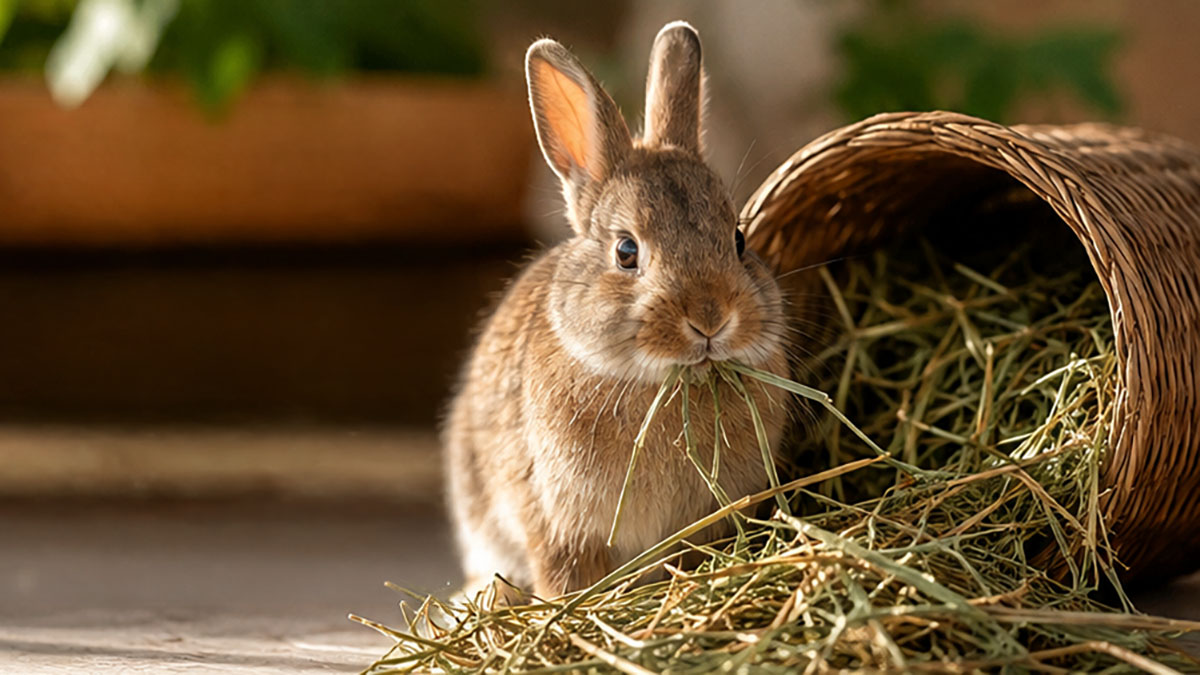
Toys, hutches, and even pellets tend to get a lot of attention. They can be fun to shop for. But hay is the quiet workhorse of rabbit care. Grass hay lets rabbits do what they are built to do for hours on end: chew, nibble, sort, tug, and forage. That steady chewing matters. Chewing naturally helps wear down teeth that never stop growing. The long hay fibers help keep the gut moving. And the simple act of searching through hay, choosing the best pieces, and settling in for another mouthful gives a rabbit’s busy foraging mind something completely natural and soothing to do.
Why hay is most of the diet
The big picture is simple. Grass hay should be the vast majority of an adult rabbit’s diet—NC State University’s College of Veterinary Medicine puts it at 75 to 80 percent. Pellets and leafy greens fill in the rest in small, measured amounts. The hay rack should be the biggest thing in the setup, not the smallest.
-
Fiber
The long hay fibers help keep the gut moving.
-
Chewing
Chewing naturally helps wear down teeth that never stop growing.
-
Foraging
Chew, nibble, sort, tug, and forage.
Hay does three things at once. Fiber keeps the digestive tract moving, and this matters more for rabbits than for most animals—a rabbit’s digestive system only works in one direction, so if the gut slows down or stops, there’s no way for the body to clear the backup. What starts as a quiet belly can become an emergency surprisingly fast. University of Illinois veterinarians name reduced appetite and fewer droppings as warning signs and recommend early intervention. If a rabbit stops eating, or its droppings shrink or stop, contact a rabbit-experienced vet right away.
The steady grind of long stems wears down teeth that grow continuously throughout a rabbit’s life—without that wear, teeth can overgrow and cause real pain.
And then there’s the benefit that’s easy to overlook: hay gives a rabbit something to do. Rabbits are natural foragers—given the chance, they’d spend hours browsing through grasses, choosing what to eat and what to pass by. A rabbit with a well-stocked hay supply can dig through it, sort the pieces, pull out favorites, and settle in for long stretches of quiet, contented chewing. That kind of self-directed activity is one of the quiet pleasures of sharing a home with a rabbit—watch yours work through a fresh pile sometime, nose going, sorting through stems, nosing out the best pieces. That focused, unhurried contentment? That’s what it looks like when a rabbit is having a genuinely good day. The hay made that happen.
Timothy vs. orchard vs. meadow vs. oat vs. alfalfa
Swipe sideways to compare every column
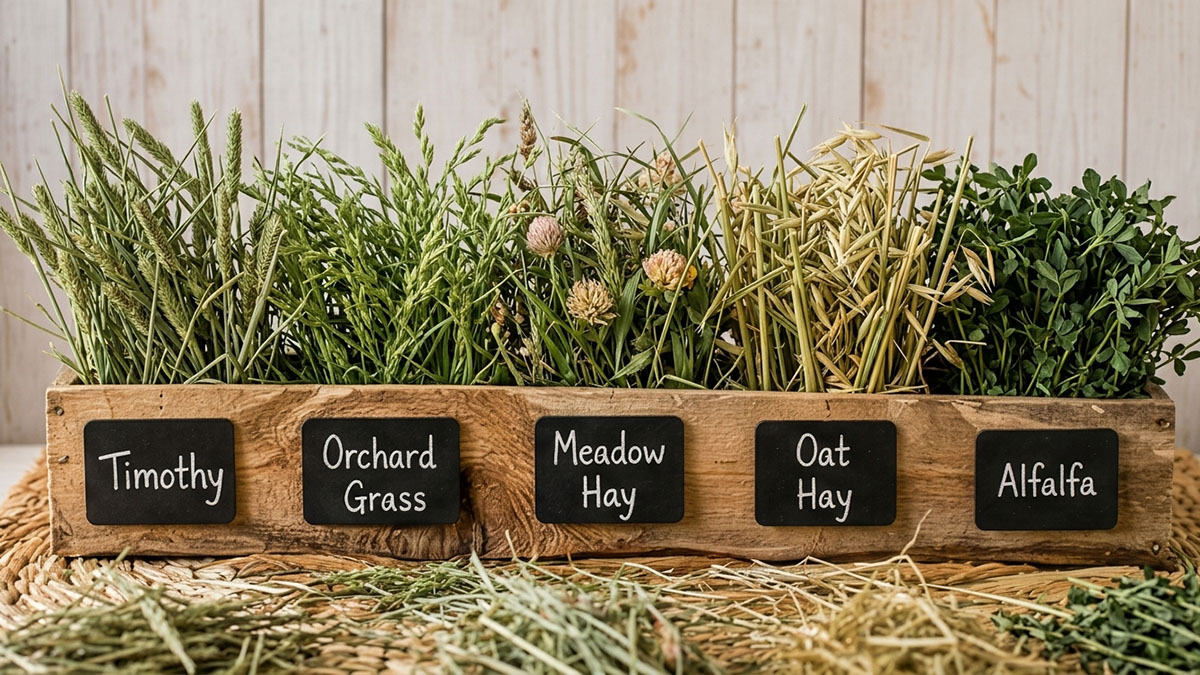
| Hay | Type | Best for | Good to know |
|---|---|---|---|
| Timothy | Grass | Most healthy adults; the go-to recommendation. | Cut matters—see the timothy guide. |
| Orchard grass | Grass | Picky eaters; softer and sweeter than timothy, and an excellent mixer. | Some rabbits prefer it so strongly they’ll ignore other hays—mixing keeps variety in the diet. |
| Meadow / mixed grass | Grass mix | Variety; the closest thing to a wild rabbit’s browse. | Know your supplier—unidentified plants in the mix are a no. |
| Oat hay | Grass (plus seed heads) | Boredom-breaking texture; many rabbits love picking through the heads. | Best as part of a mix rather than the only hay; the seed heads are starchier than plain grass stems. |
| Alfalfa | Legume | Young rabbits, nursing does, and (on a vet’s advice) ill rabbits that need to gain weight. | Too much protein and calcium for most healthy adults. |
The grass hays in this table aren’t the only options: Veterinary Partner also lists rye, barley, and Bermuda grass hay as good grass hays for rabbits, and University of Nebraska–Lincoln Extension adds brome. Whichever variety you find, the same freshness and quality checks apply.
Mixing hays tends to work better than sticking with just one kind. A little orchard tossed in with the timothy, a handful of oat hay on a different day—it keeps things interesting, and it’s closer to how a rabbit would eat in a meadow if given the choice.
High-fiber hay for rabbits
Once you start reading about rabbit diets, you’ll see that phrase everywhere. That’s because fiber really is the whole point. In truth though, “high-fiber hay” just means long-strand grass hay: timothy, orchard, oat, meadow. Any well-grown, properly cured grass hay is high-fiber hay by nature. First-cut timothy tends to have the most stem and the highest fiber, and orchard and meadow run exceptionally close behind when they come from a grower who harvests and dries the crop in good conditions. (Hay quality depends a lot on weather and timing—a batch grown and cured during a stretch of dry sun will have stronger stems and better structure than one that sat in rain or was baled too early. If you find a supplier whose hay is consistently good, hold on to them.)
Compressed hay cubes can be handy for travel or as an occasional supplement, but they aren’t a stand-in for loose, long-strand hay—a rabbit can’t dig through a cube and forage the way they would through a pile of loose hay, and the chewing action is different. And those brightly packaged forage blends that mix in seeds, dried fruit, or dyed pieces? They’re designed to catch a shopper’s eye more than to feed a rabbit well. What a rabbit needs from hay is simply the hay itself—plain, long stems and intact leaves that take real work to chew through.
A good test: if you can see long stems with the leaves still on, and it smells like dried grass rather than candy, it’s the right kind of fiber.
Swipe sideways to compare every column
| Hay | Crude Fiber bar: 20–40% scale | NDF total fiber | ADF less-digestible fiber |
|---|---|---|---|
| Timothy | 33–34% | 68–70% | 43–45% |
| Orchard grass | 34% | 70% | 40% |
| Meadow / mixed | 33% | Not listed | Not listed |
| Oat hay | 30% | 63% | 38% |
| Alfalfa for contrast | 29–30% | 47–50% | 35–38% |
What NDF and ADF mean for your rabbit: NDF measures all the fiber in a plant’s cell walls. ADF is the tougher part of that fiber, and Colorado State University Extension notes it is closely tied to how digestible a feed is. Veterinary Partner explains that hay gives rabbits both kinds of help: “food” for the helpful microbes in the gut, and indigestible fiber that keeps the intestines moving. The main story the chart tells, though, is simple: the grass hays sit close together, and any of them will do the job, while alfalfa runs lower in fiber.
Rabbits are ground foragers at heart. They like to nose through a pile, sort out favorite stems, and tug mouthfuls loose. The goal is to keep hay clean and fresh without making it so contained that your rabbit loses that natural foraging experience.
Wild rabbits move from place to place as they graze. A house rabbit has a much smaller world, so keeping hay fresh takes a little help from you. Check it often, remove anything damp or soiled, and top it up regularly. A hay ball may be useful, but it shouldn’t replace a generous supply of loose hay. You can also offer loose hay in more than one spot around your rabbit’s space.
One simple setup is a large litter box with a generous pile of hay at one end. Many rabbits like to eat while they use the box, and a roomy box gives them enough space to choose a bathroom corner while leaving much of the hay in a cleaner area.
If you use a hay rack or basket, make sure the openings are large enough for your rabbit to pull hay through easily. Some designs hold hay so tightly that getting a mouthful becomes more work than it should be.
How much hay, really
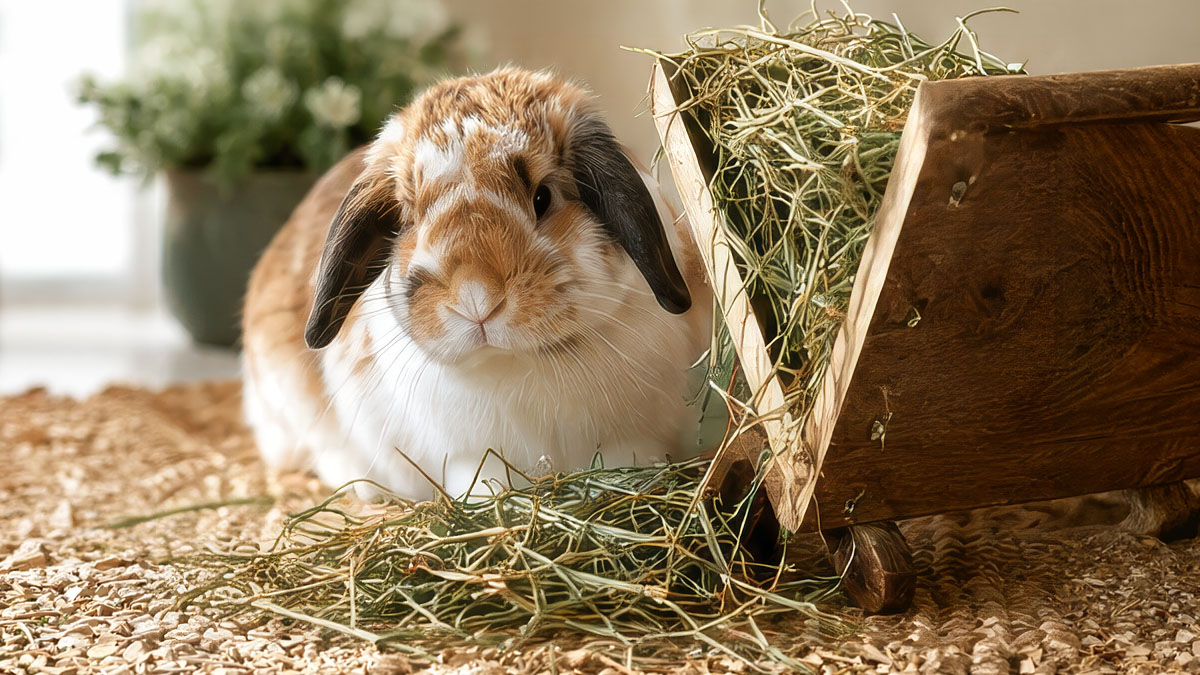
Unlimited, and refilled before the pile disappears. Provide a grass hay pile at least as big as your rabbit—as a starting point, not as an upper limit. There’s something satisfying about watching a rabbit settle into a generous pile of hay, nose twitching, sorting through it for the best pieces. Watching a single long stem slowly disappear into a busy, twitching mouth—a steady nom-nom-nom-nom like a little green magic trick—never gets old. That’s exactly what you’re going for.
Two rabbits need two piles—they may not share politely. And if a lot of hay is going to waste, try a different cut or a different type before you try offering less. Hay that’s been eaten down to nothing but the tough stems is telling you which pieces they enjoy most. Hay that’s been sat on and ignored is usually a freshness problem—not a picky rabbit.
Quality, dust, and mold
Many owners expect bad hay to look like white, fuzzy bread mold, but moldy hay rarely looks obvious. Long before spores become visible, mold sometimes reveals itself through smell and texture. Bad hay can smell musty, sharp like vinegar, earthy like a damp basement, or simply “flat” and devoid of that crisp, sweet grass aroma. Good hay should feel crisp and structured in your hands rather than powdery or limp. While farm-baled hay naturally carries a touch of dust, heavy plumes can irritate delicate rabbit lungs. Watch out for moisture, too—bags left resting on concrete or dirt floors often absorb ground dampness. If you reach into the center of a bag or bale and it feels warm, heavy, or tightly clumped together, trapped moisture is already fermenting the grass. Any hay generating its own warmth or lacking a fresh, sweet smell has ceased to be rabbit-safe food; it should be discarded immediately.
Where to buy, and how to store it
Dedicated rabbit-hay companies, local farm stores, or a grower who understands small animals all beat a clear plastic bag that’s been sitting under bright store lights for a season. Ask when the batch was cut. Feel the weight, check for green color, and don’t hesitate to smell the bag right there in the aisle—fresh hay has a clean sweetness you can catch immediately. Checking for quality before heading to the register saves a lot of wasted money and trips back to the store.
Once you get it home, store your hay in a breathable container—like a fabric bin, a wooden chest, or even a cardboard box with ventilation holes. Keep it elevated off concrete floors in a cool, dry spot away from humidity/dampness, direct sunlight, other pets, insects, or mice. If you purchase in bulk, divide the supply into smaller batches. That way, a sudden moisture leak or an unwanted pest won’t ruin your rabbit’s entire feed stash.
Pellets, greens, and the rest of the plate
Once the hay is right, pellets get to be boring—and boring is a good thing. NC State University recommends a plain, uniform timothy-based pellet with no added fruits, nuts, or seeds, measured out daily: about ¼ cup per 5 pounds of body weight each day. Veterinary Partner gives a similar figure, about ¼ cup per 4 pounds, with no more than ⅛ cup a day for dwarf rabbits, and warns that pellets are easy to overfeed because a rabbit keeps acting hungry. A real measuring cup helps. The fresh item on the menu comes from greens: NC State suggests about ½ cup of leafy greens per 2 pounds of your rabbit’s body weight each day. Once your rabbit is used to greens, Purdue recommends at least three different kinds daily, rather than the same lettuce continually. Most rabbits light up when they hear the fridge open—that’s the greens doing their job. The greens guide covers which leaves to choose and how to introduce them slowly. Fruit is a treat only, a small piece now and then, not a regular helping. For the foods that don’t belong in the bowl at all, the unsafe foods guide is a fast read.
Key Takeaways
- Source rabbit hay from trusted growers who understand rabbit health concerns.
- Hay needs to be roughly three-quarters or more of an adult rabbit’s diet. Give unlimited grass hay, every day.
- Timothy, orchard, meadow, and oat are the everyday grass family that your rabbit needs in abundance. Alfalfa is reserved for specialist situations.
- “High-fiber hay” is simply long-strand grass hay: timothy, orchard, oat, meadow.
- Use your nose and hands to check hay for mold, dampness, or dust. If the hay doesn’t smell and look wonderful, throw it out (or compost it / bury it in the garden.)
Sources
The diet figures on this page follow the U.S. veterinary sources listed below, checked August 2026.
- NC State University College of Veterinary Medicine, “Caring for Your Pet Rabbit”—grass hay at 75–80% of the diet; alfalfa only for rabbits under six months and lactating does; about 1/4 cup pellets per 5 lb daily; about 1/2 cup greens per 2 lb daily; fruit in very small amounts a few times a week; not eating for more than 12 hours is always an emergency.
- University of Illinois College of Veterinary Medicine, “Rabbit Gastrointestinal Stasis Syndrome” (Michelle C. Borsdorf, DVM, DACZM)—fiber as essential to GI motility; more than 75% grass hay; low fiber and rapid diet change among the causes; reduced appetite past four hours, refusing treats, or reduced droppings as warning signs; “Early intervention is recommended.” Supports the vet line in “Why hay is most of the diet”; grass hay examples “timothy, orchard grass, meadow, etc.” (grass-hay examples checked September 18, 2026).
- Veterinary Partner, Veterinary Information Network, “Rabbit Care: Diet and Nutrition” (Susan Brown, DVM; Logan Kopp, DVM—July 2024)—grass hays made from timothy, meadow, oat, rye, barley, or Bermuda grasses, with a mix of two or more types preferred; legume hays such as alfalfa too rich to be the routine hay for an adult house rabbit; pellets “based on grass hays (timothy, orchard grass, brome, etc.), not alfalfa hay,” with a veterinarian advising alfalfa-based feeding for ill rabbits that need to gain weight; about ¼ cup pellets per 4 lb daily for healthy rabbits other than giant breeds, and a ⅛ cup daily maximum for dwarf rabbits; pellets easy to overfeed; hay as “food” for gut micro-organisms and a source of indigestible fiber for motility. This entry, including its guidance on brome hay, checked September 12, 2026; pellet, alfalfa, and fiber details checked September 22, 2026.
- Colorado State University Extension, “Feed Composition for Cattle and Sheep,” Fact Sheet 1.615 (T.L. Stanton; revised by S. LeValley, December 2014)—“typical values” on a dry-matter basis for crude fiber, ADF, and NDF: timothy hay early bloom 33/43/68% and full bloom 34/45/70%; orchardgrass hay 34/40/70%; oat hay 30/38/63%; meadow hay crude fiber 33% (no ADF or NDF listed); alfalfa hay early bloom 29/35/47% and midbloom 30/38/50%. The fact sheet notes fiber values “can vary as much as 15 percent” from table values and that ADF “is highly related to digestibility.” A livestock reference: hay composition, not rabbit feeding advice. Checked September 22, 2026.
- American Veterinary Medical Association, “Rabbit hemorrhagic disease” (no individual author or date shown)—prevention tip: “Feed pelleted feed or purchase forage from unaffected states.” Also: “Talk to your veterinarian about appropriate disease control protocols.” Supports the RHDV2 note and the veterinarian pointer in the hay-supplier box. Checked September 22, 2026; veterinarian line checked October 3, 2026.
- Purdue University College of Veterinary Medicine, “Rabbit Care for Pet Owners” (institutional guidance; no individual author or publication date shown)—“A minimum of three different greens should be fed daily, but the more variety the better”; greens added gradually once a hay-based diet is established. Supports the daily greens-variety sentence. Checked September 17, 2026, for the greens guide.
- University of Nebraska–Lincoln Extension (Institute of Agriculture and Natural Resources), “Rabbit Resources” (scanned 4-H resource packet; no individual author or original publication date shown; posted December 2024)—“The following grass hays can be fed ‘Free Choice’ to rabbit: Timothy, Orchard Grass, Brome, Oat Hay, or Prairie Hay.” Supports brome, orchard, and oat as suitable grass hays. Checked September 18, 2026.
- PetMD, “How To Litter Train a Rabbit” (written by Melissa Witherell, DVM; reviewed by Lauren Jones, VMD; updated March 3, 2026)—“It’s also helpful to put some hay in the corner of the litter box—it’s common for rabbits to go to the bathroom and have a snack at the same time.” Supports the litter-box hay setup in the Hutch Tip on keeping hay fresh. Checked September 30, 2026.
- Merck Veterinary Manual, “Providing a Home for a Rabbit” (Laurie Hess, DVM, DABVP; full review July 2026)—safe litter “options include recycled newspaper pellets, paper pulp, or hay. If hay is used, replace it daily”; “Hay racks decrease waste and keep hay cleaner than putting hay directly on the floor.” Supports the Hutch Tip’s advice to keep hay clean and fresh, and the hay-rack note. Checked September 30, 2026.
- Wisconsin Humane Society, “Litter Box Training your Rabbit” (no individual author shown; updated January 28, 2026)—“A large quantity of your rabbit’s defecation will occur while they are eating,” so hay goes inside the box or in a rack right next to it. A U.S. shelter’s husbandry guidance, used as a cross-check on the litter-box hay setup. Checked September 30, 2026.
Found this helpful? The kindest thing you can do is leave a tip or share it with another rabbit person—every guide here stays free, always.
Get rabbit care tips
Join the Hutch list—I write when there’s something worth hopping over for, not every other Tuesday.