

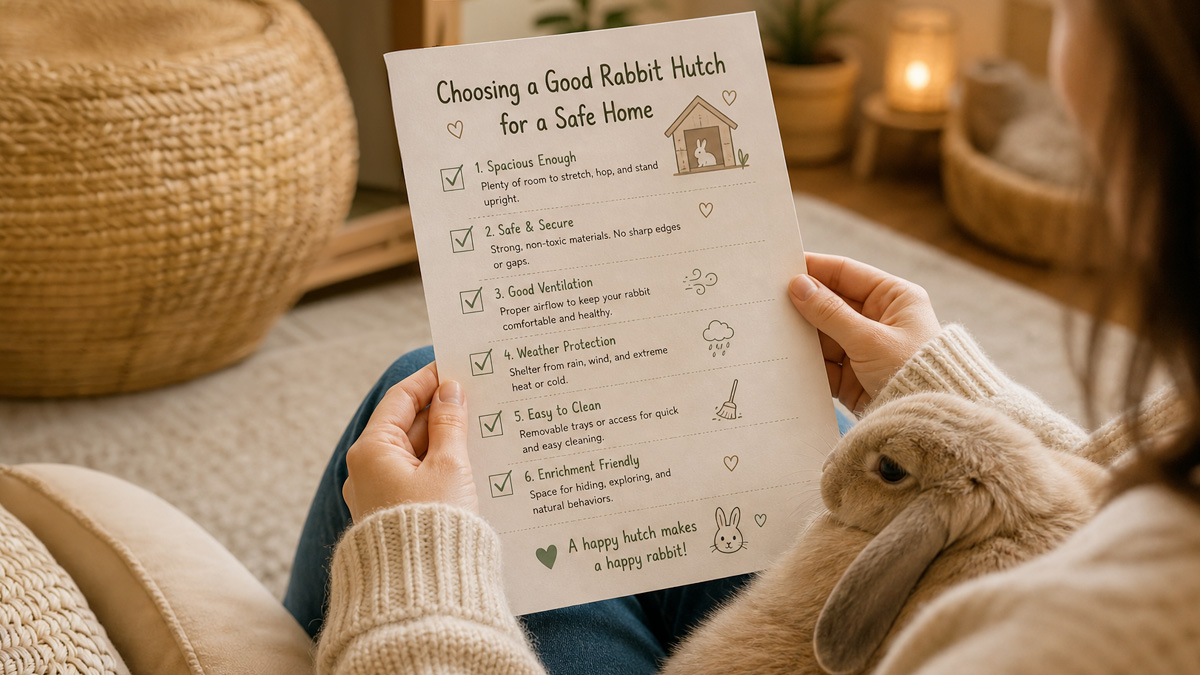
Quick answer: What makes a good rabbit hutch?
A good hutch for one rabbit is at least four times as long as your adult rabbit and twice its length in width, tall enough for the rabbit to stand on its hind legs, with a solid floor instead of bare wire. It lives indoors, or inside a fully enclosed barn or shed, and it’s a home base, not the whole world: daily time out matters just as much. Get those right, and a hutch can be a cozy, happy den.
One listing says “spacious.” Another says “deluxe two-story.” The photos show tidy little ramps, pull-out trays, and a rabbit who looks perfectly content. But could that rabbit stretch out full length, stand up tall, or take more than one hop? This checklist helps answer that, whether the hutch comes from a store or a workbench.
The Hutch Checklist
| Length | At least 4 times your adult rabbit’s length |
|---|---|
| Width | At least 2 times your rabbit’s length |
| Height | Tall enough to stand up on hind legs |
| Floor | Solid, with soft resting spots; no bare wire |
| Airflow | Open mesh sides; never a glass tank |
| Cleaning | Doors wide enough to reach every corner |
| Latches | Easy for people, impossible for noses |
| Materials | Nothing painted, stained, or sharp within chewing reach |
| Location | Indoors, or inside a fully enclosed barn or shed |
| Beyond the hutch | Daily time out in a safe space |
Size: The Minimum Isn’t the Goal
Size is where hutches most often fall short, and the experts don’t agree on the numbers. The Merck Veterinary Manual’s owner guide lists minimums as small as 18 by 24 inches for a small breed. UC Davis’s veterinary school measures by the rabbit instead: at least four times the rabbit’s length, and twice its length in width. PetMD’s veterinarian-written guide goes further, with at least 3 feet of length for small and medium rabbits and 10 feet for giants like the Flemish Giant.
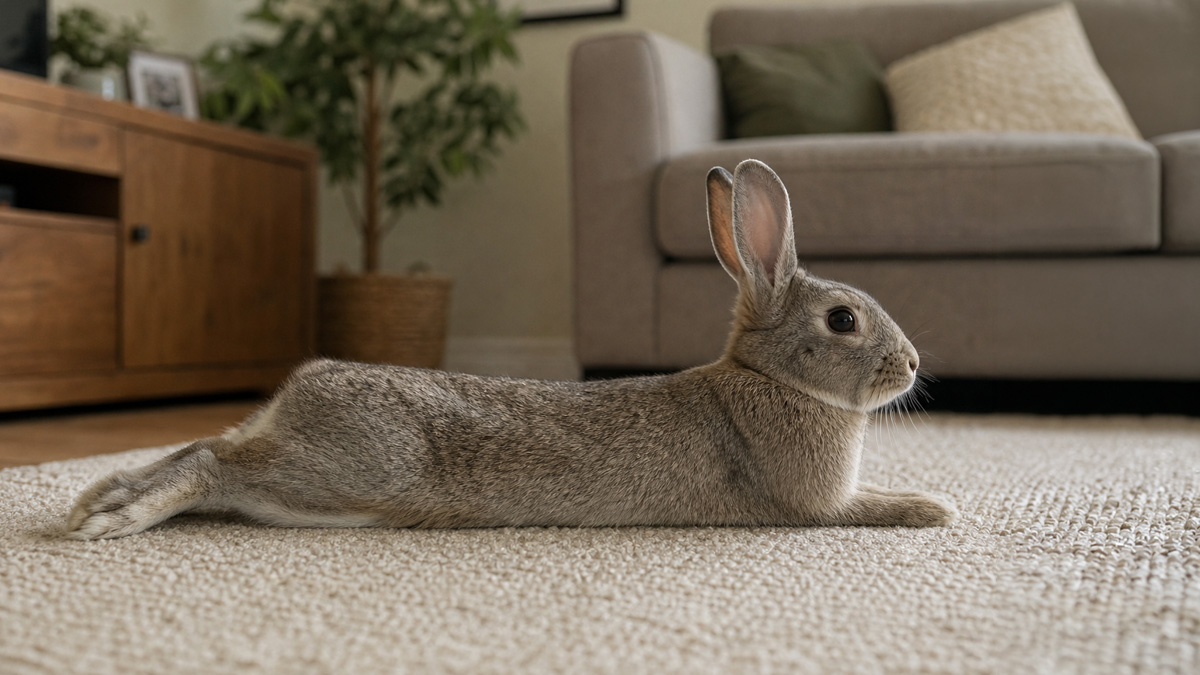
Treat the smallest numbers as a starting line, not a goal. Measure your rabbit stretched out, nose to back stoes (or use its expected adult size), and do the math: an 18-inch rabbit needs a hutch about 6 feet long and 3 feet deep. Measure the inside floor, not the outside of the box. Ramps and second stories add a little room, but they don’t replace a long, open floor for hopping. The chart below does the math for a few common sizes. Dimensions are inside length × depth.
| Rabbit length, stretched out | Floor for one rabbit | Floor for two rabbits |
|---|---|---|
| 12 inches | 4 × 2 ft (8 sq ft) | Example: 4 × 4 ft (16 sq ft) |
| 15 inches | 5 × 2½ ft (12½ sq ft) | Example: 5 × 5 ft (25 sq ft) |
| 18 inches | 6 × 3 ft (18 sq ft) | Example: 6 × 6 ft (36 sq ft) |
| 24 inches | 8 × 4 ft (32 sq ft) | Example: 8 × 8 ft (64 sq ft) |
For two rabbits of different sizes, use the larger rabbit’s stretched-out adult length for the “Floor for two rabbits” column. Other dimensions can provide the same floor area, as long as the inside length and depth still meet the guidance above.
Those bigger numbers surprise a lot of people. Larger rabbits quickly outgrow most store-bought hutches, and for them a roomy exercise pen or a rabbit-safe room is often the practical answer.
Floors and Feet
Look underneath before anything else. Rabbits don’t have thick pads on the bottoms of their feet the way dogs and cats do, the University of Florida’s veterinary hospital points out, and the Merck Veterinary Manual warns that rabbits kept on wire or wooden floors for long periods can develop sore hocks, painful sores on the heels. UC Davis and the University of Florida both recommend a solid floor instead of wire.
Many hutches have a wire floor over a pull-out tray: easy to clean, hard on feet. Even Merck, which allows wire, says the rabbit needs a smooth resting area. The kinder choice is a solid floor from the start, with a washable rug or mat on top for resting.
Airflow, Cleaning, and Latches
Merck calls good ventilation “imperative,” and mesh sides are an easy way to get it. Skip glass aquariums: Merck says they don’t let enough air circulate.
Then picture cleaning day. Doors should open wide enough to reach every corner, because a hutch that’s hard to clean tends to get cleaned less. Latches should be simple for a person and impossible for a curious nose to nudge open.
Rabbits chew, so check what they can reach. PetMD’s guide suggests avoiding wood for that reason. If a hutch is wood, look for bare, untreated wood inside (Merck lists untreated wood among good chews), with no paint, stain, staples, or loose wire ends where teeth can find them.
Where the Hutch Lives
Where a hutch sits matters as much as how it’s built. The University of Florida’s veterinary hospital puts it simply: “Cages should be kept inside.” In the house, a spot near the everyday life of the family is ideal, away from direct sunlight and drafts.
The other good home for a hutch is inside a fully enclosed barn or shed, with solid walls, a sound roof, and doors that close. That way the building, not the hutch, stands between the rabbit and the weather and wildlife outside. Choose a space that’s pleasant for people too, dry and comfortable enough to sit in for a while, because a rabbit out there still needs company every day, and you’ll be the one visiting.
A Home Base, Not the Whole World
Even the best hutch is a bedroom, not a whole life. Merck says rabbits need daily time out in a safe, supervised area, and NC State’s veterinary hospital suggests at least a few hours a day in a pen or rabbit-proofed room. Purdue goes further: ideally, rabbits live in large pens rather than cages. A hutch that opens onto a pen or a rabbit-safe room gives a rabbit both: a den to retreat to, and space to run and flop out flat. For the rest of a starter setup, from hides to litter to chew-proofing, see bringing a new rabbit home.
FAQ
Are rabbits happy in a hutch?
They can be, when the hutch is roomy and comfortable and only part of their world. A rabbit with a good home base plus daily time to run and explore has what it needs. A rabbit shut in a small hutch all day does not.
Is a 6-foot hutch big enough for two rabbits?
Only for small rabbits, and only if it’s deep enough. For a pair, go by floor space, not length alone: find your rabbits’ size in the chart above and use the “Floor for two rabbits” column. Two 12-inch rabbits need about 16 square feet, so a 6-foot hutch would need to be about 32 inches deep inside. Two 18-inch rabbits need about twice what a 6-by-3-foot hutch offers. Either way, the pair still needs daily time out together.
Is a wire-bottom hutch okay?
It isn’t ideal; UC Davis advises avoiding wire floors. If a hutch already has one, a single layer of fabric isn’t enough, because the wire still presses through. The rabbit needs a firm, solid surface between its feet and the wire. Purdue’s veterinary hospital suggests covering at least half the floor with Plexiglass, and Merck calls for a smooth resting area of plastic or another washable material. Add a soft, washable rug or mat on top, and the feet get real relief. Better still, choose a hutch with a solid floor.
Sources
Housing guidance on this page comes from the veterinary, university, and veterinarian-written sources listed below, checked October 2026. Everyday setup advice is written in RabbitHutch.org’s own words and traced here.
- UC Davis School of Veterinary Medicine—“Rabbit Care.” John Gardiner; April 11, 2019. Verbatim: “The cage size should be no less than 4x in length and 2x in width of the length of your adult-sized rabbit.” “Avoid cages with wire flooring. If wire flooring is necessary, provide a solid substrate such as a mat or cardboard for the rabbit to rest on.” Backs the size ratio in the Quick answer, checklist, and Size section; the solid-floor advice; and the wire-bottom FAQ. UC Davis’s own suggestion for covering wire is “a mat or cardboard.” Checked October 3, 2026. Source link.
- Merck Veterinary Manual—“Providing a Home for a Rabbit.” Laurie Hess, DVM, DABVP; full review July 2026. Verbatim: “Small breeds: at least 18 x 24 inches (46 x 61 centimeters).” “All-wire stainless steel cages are often preferred. Wire flooring helps droppings fall away and keeps the cage cleaner, but rabbits also need a smooth resting area on the cage bottom made of plastic or another washable material to decrease pressure on the bottom of their feet and keep sores from developing.” “Good chewing materials include hay, cardboard, straw, untreated wicker and wood, and pine cones that have been cleaned and dried.” “…rabbits also need daily time out of the cage in a safe, supervised area.” Backs the small-breed minimum, the resting-area note (in “Floors and Feet” and the wire-bottom FAQ), untreated wood, and daily time out. RabbitHutch.org follows UC Davis and the University of Florida in preferring a solid floor over wire. Checked October 3, 2026. Source link.
- Merck Veterinary Manual—“Housing of Rabbits.” Professional version; Joerg Mayer, DVM, DABVP (ECM), DECZM, DACZM; last updated September 2024. Verbatim: “The cage should be tall enough to allow the rabbit to stand on its hindlimbs.” “If the rabbits are housed on wire or wooden flooring for long periods, sore hocks might develop.” “Aquariums are not appropriate housing for rabbits (or other small mammals) because of inadequate air circulation.” “Good ventilation at all times is imperative.” Backs the height guidance, the sore-hocks warning in “Floors and Feet,” and the airflow advice. Checked October 3, 2026. Source link.
- University of Florida Small Animal Hospital—“How to Care for Your Pet Rabbit.” Institutional care page; no author or date shown. Verbatim: “The flooring of the enclosure should be a solid dry surface, not wire (i.e. carpet, wooden board) including bedding of towels and straw so their feet do not become irritated (rabbits do not have pads on the bottoms of their feet like dogs or cats.)” “The enclosure should be tall enough for your rabbit to be able to stand on its hind legs and stretch out.” “…be sure to find a spot away from direct sunlight or drafts.” “Cages should be kept inside.” Backs the foot-pad note, solid floor, height, and placement. Checked October 3, 2026. Source link.
- NC State Veterinary Hospital—“Caring for Your Pet Rabbit.” Institutional care page; no author or date shown. Verbatim: “Rabbits need lots of space to stretch their legs, so your rabbit should have at least a few hours outside his/her cage in a pen or rabbit-proof room.” Backs “A Home Base, Not the Whole World.” Checked October 3, 2026. Source link.
- Purdue University College of Veterinary Medicine—“Care of Rabbits.” Institutional care page; last updated June 25, 2026. Verbatim: “A roomy wire cage with at least one-half of the floor’s surface area covered with Plexiglass or washable towels is recommended.” “Rabbits should be encouraged to exercise daily; ideally, they should not be kept in cages but rather in large pens.” Backs the Plexiglass suggestion in the wire-bottom FAQ (RabbitHutch.org recommends the firm option over towels) and the large-pen note. Checked October 3, 2026. Source link.
- PetMD—“A Rabbit Cage Guide for Pet Parents.” By Melissa Witherell, DVM; published April 22, 2026. Verbatim: “Smaller to medium rabbits (such as the Dwarf or Dutch rabbits) need at least 24″ W x 24″ H x 36″ L. Larger breeds (such as the Flemish Giants) need at least 36″ W x 36″ H x 120″ L.” “For multiple rabbits, double the recommended space per rabbit.” “Wood material should generally be avoided, as rabbits tend to chew them.” Used for size figures, doubling the space for two rabbits, and the note on wood; the foot-health claim on this page comes from Merck. Checked October 3, 2026. Source link.
- Judgment calls. Measuring the rabbit stretched out; the 18-inch worked example; measuring the inside floor; the note on ramps and second stories; the cleaning-access and latch advice; keeping painted, stained, or sharp surfaces out of chewing reach; the size chart, the worked examples, and the two-rabbit FAQ (the UC Davis ratio applied to each rabbit, then doubled per PetMD; the 12-, 15-, 18-, and 24-inch rows are illustrative sizes, not breed measurements; using the larger rabbit’s length for a mixed-size pair and allowing other dimensions that preserve the floor area and length/width guidance are practical judgment calls); the note that larger rabbits often need a pen or rabbit-safe room instead of a store-bought hutch; the note that a single layer of fabric isn’t enough over wire; the suggestion that an outbuilding be pleasant for people because the rabbit needs daily company; and placing a hutch indoors or inside a fully enclosed barn or shed (RabbitHutch.org’s housing stance) are RabbitHutch.org’s own reasoning, built on the sourced facts above rather than quoted from any one source.
Found this helpful? The kindest thing you can do is leave a tip or share it with another rabbit person—every guide here stays free, always.
Get rabbit care tips
Join the Hutch list—I write when there’s something worth hopping over for, not every other Tuesday.