Quick answer: Is timothy hay good for rabbits?
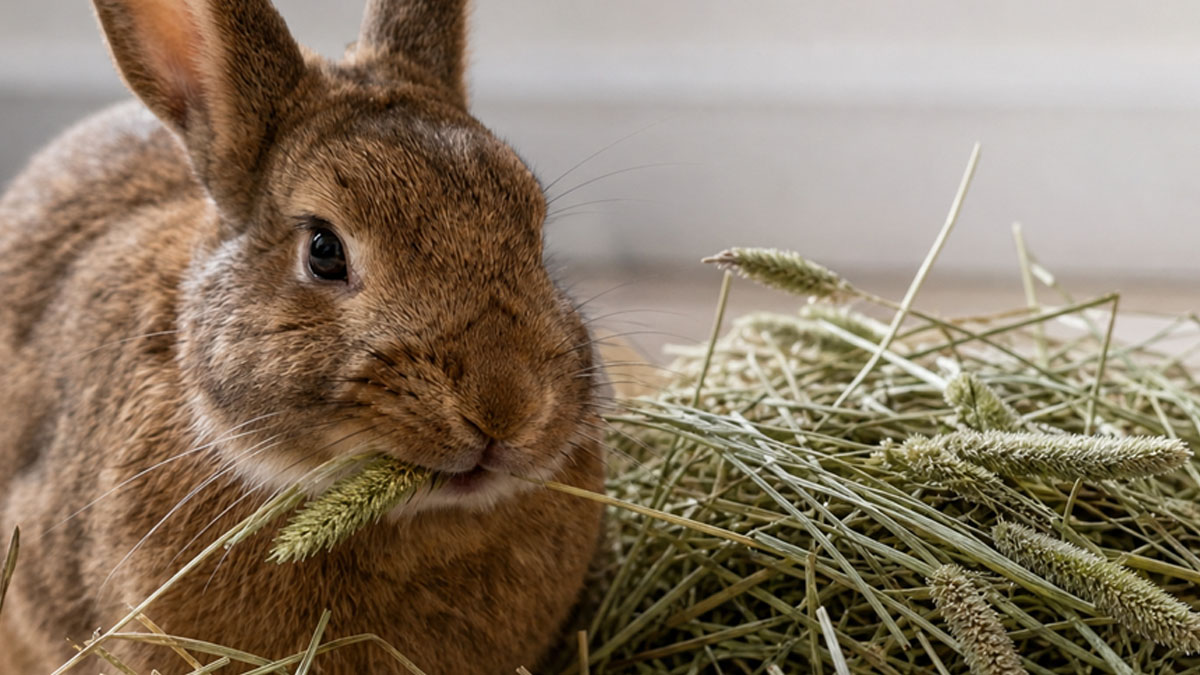
Timothy hay is a high-fiber grass hay that can be offered in unlimited amounts and should make up the bulk of a healthy adult rabbit’s diet. It supports digestion and the natural grinding motion that keeps a rabbit’s teeth in good condition. Orchard, meadow, oat, and brome are suitable grass hays too, while alfalfa, richer in protein and calcium, is generally reserved for growing or nursing rabbits and other cases guided by a rabbit-savvy veterinarian. From there, it’s just a matter of finding the hay your rabbit loves best.
What timothy hay actually is
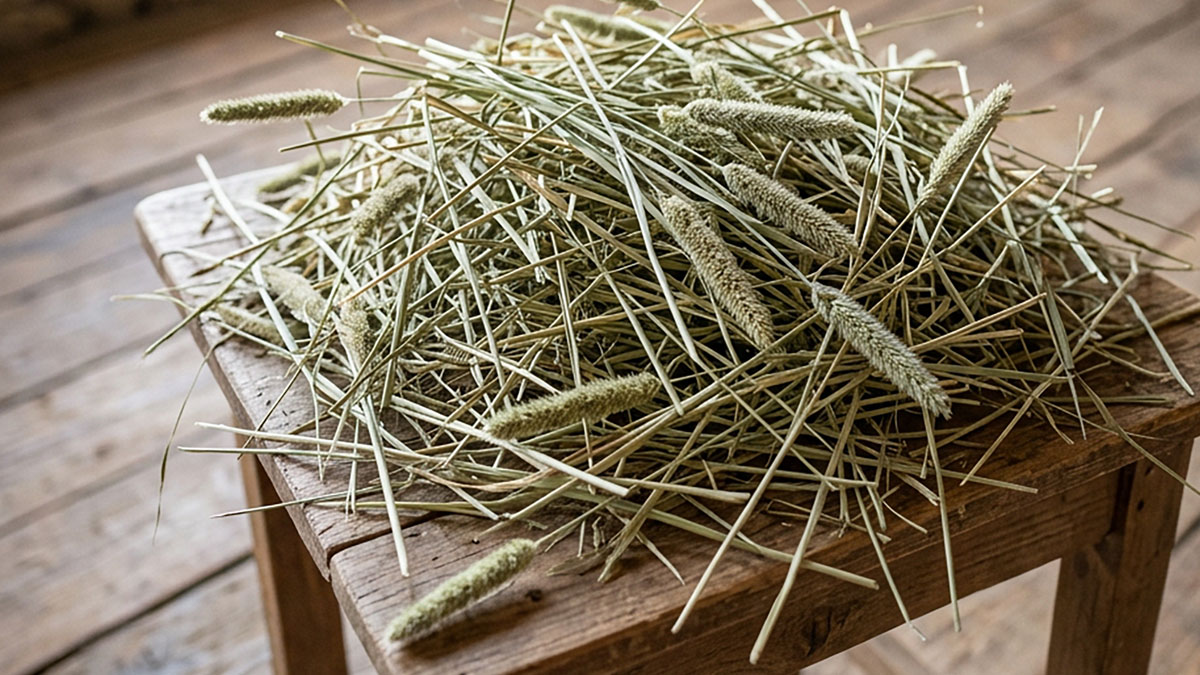
Timothy is a perennial grass, Phleum pratense, grown as forage. In the bag it looks like a mix of slender stems, seed heads (those little “caterpillar” spikes), and green leaf. It’s a grass hay, which means it’s lower in protein and calcium than a legume hay like alfalfa. That’s exactly why timothy suits a healthy adult rabbit.
The veterinary sources all land in roughly the same place. NC State’s College of Veterinary Medicine puts high-quality grass hay at 75–80% of the diet. The University of Illinois College of Veterinary Medicine says more than 75% grass hay, and calls fiber “essential for GI motility.” Veterinary Partner (VIN) skips percentages entirely and simply says grass hay should always be available as the bulk of what a rabbit eats. Timothy is the hay all three name first.
Why timothy hay is good for rabbits
Timothy is filling without being rich, so a rabbit can graze on it for hours. That long, slow nibbling isn’t the bunny’s way of killing time; it’s how rabbits are built to eat. All that munching does two jobs at once: the long-strand fiber keeps the gut moving, and the steady grinding wears down teeth that never stop growing.
Researchers at the University of Edinburgh’s veterinary school saw both jobs at work. Rabbits eating the most hay made plenty of big, round droppings, which is a welcome sign that food is moving through the gut the way it should. Rabbits fed mostly seed-and-grain mixes ended up with back teeth that grew too long, and some began to curve, early signs of dental trouble. Rabbits fed hay kept their back teeth short and straight, the way they should be.
Timothy is common and easy to recognize, but it is not magic. Orchard, meadow, oat, and brome are also grass hays. A fresh grass hay your rabbit eats eagerly is more useful than a celebrated bag of timothy they keep pushing aside.
How much timothy hay does a rabbit need?
Unlimited. A healthy rabbit should never run out. If “unlimited” feels too vague to act on, start with a fresh pile at least as big as the rabbit and refill it before the pile disappears. A little clean hay left over is better than an empty rack overnight.
Pellets and leafy greens have their own smaller places in the diet, but neither replaces hay. They round out the menu; grass hay is the part that stays available all day, ready whenever a rabbit wanders back for another chew.
Can rabbits live on only timothy hay?
No. Timothy or another grass hay should be the largest part of an adult rabbit’s diet, but hay is not the entire diet. Fresh water must always be available, and veterinary feeding guides also include measured plain pellets and appropriate leafy greens. The exact amounts can change with a rabbit’s size, age, health, and body condition.
First cut, second cut, third cut
When you see hay labeled first, second, or third cut, that isn’t a quality grade. It identifies when that hay was harvested during the growing season. Those different harvests can produce hay that looks, feels, and even feeds differently.
-
First cut
The spring harvest, when the plant has put its energy into stems. The hay is coarser, more fibrous, often more yellow-green, with obvious seed heads. Some rabbits adore the crunch and others pick around it. It’s the highest-fiber option, and a gift to a rabbit who needs more chewing and fewer calories.
-
Second cut
The usual recommendation, and for good reason. More leaf, still plenty of stem, a sweeter grassy smell, and a texture most rabbits will actually finish. If a store sells “timothy hay” with no other label, this is almost always what they mean.
-
Third cut
Late, leafier, softer, and a little richer. It can be perfect for a picky eater, a senior who struggles with coarse stems, or a rabbit whose appetite is coming back after an illness.
If you can, keep two cuts in the house. A rabbit who has gotten bored with second cut will often dive into a handful of stemmy first cut like you just invented snacks. Rotation is cheaper than a new toy, and sometimes more engaging.
Timothy or orchard hay: which is better?
Neither is better for every rabbit. Timothy and orchard are both high-fiber grass hays recommended for healthy adults. Timothy is often stemmier; orchard grass is usually softer, which can make it easier for some rabbits to enjoy. You can feed either one, mix them together, or rotate them. The best everyday hay is fresh, clean, and eaten eagerly.
Is timothy hay good for young rabbits?
Timothy grass hay can be introduced while a young rabbit grows, but alfalfa is commonly used as the main hay during the early months because its extra protein and calcium support growth. NC State recommends alfalfa for rabbits under six months. Your rabbit’s veterinarian can help choose the timing, especially for a rabbit who is underweight, recovering, or growing unevenly.
When you switch a youngster onto timothy, go slowly and mix the two over a couple of weeks. Rabbits really don’t appreciate a sudden new menu, and this is one place where taking your time genuinely matters. The University of Illinois lists rapid diet change among the direct causes of GI stasis.
What hay is not good for rabbits?
A hay can be wrong for two different reasons: it may not suit the rabbit’s life stage, or it may simply be poor hay. Alfalfa is generally too rich for a healthy adult’s everyday hay. Moldy, damp, musty, or very dusty hay is unsuitable for every rabbit, whatever type is printed on the bag.
Rabbits are honest hay critics. A fresh pile gets tugged apart, sorted, and worked down to the best-smelling pieces; a stale bag may be left sitting. Good hay smells sweet and green, like a field after a dry morning—not perfumed, sour, or like a box forgotten in the garage. It should feel dry but not brittle, with pliable stems, plenty of leaf, a gentle rustle, and almost no powder on your palms. Any hint of must, heat, dampness, or white fuzz means that whole bag is a no go.
Color should be green to green-gold. Brown is tired, and gray is a warning. Plenty of seed heads is normal in first cut, but a bag of nothing but powdery leaf with no structure will not provide the same long chewing time as a stem-and-leaf mix. If you find a plant you cannot identify in the hay, do not assume it is safe—ask the supplier or skip that batch. A bag that’s more stick than grass, or damp in the middle, goes back to the store.
Storage
Hay needs to breathe. A sealed plastic tub in a warm room is how you grow a science experiment. Keep it in its paper bag or a breathable hay sack, up off the floor, out of the sun, and well away from damp walls. Buy what you’ll finish while it is still fresh—bulk is only a saving if the last handful is as good as the first.
When a rabbit refuses timothy
Start with the hay, not the rabbit. Old, dusty, or stem-only timothy is a perfectly reasonable thing to turn down. Try a different cut, or mix in orchard grass or meadow hay—the complete hay guide walks through those. Offer one fragrant strand by hand as if it were a treat; some rabbits will taste an unfamiliar cut that way, then go back to investigate the pile. And check whether pellets have quietly taken over dinner; that’s an easy thing to over-scoop when you’re worried they aren’t eating enough.
Key Takeaways
- Timothy is an excellent everyday grass hay for most healthy adult rabbits, but orchard, meadow, oat, and brome are good choices too.
- Offer unlimited grass hay and refill it before the pile disappears.
- Second cut is the everyday default; first cut is fiber-forward; third cut is softer and richer.
- Alfalfa suits growing and nursing rabbits and some special cases—but not most healthy adults.
- Judge hay with your nose and your hands: sweet, green, barely any dust, no mold.
- A rabbit who stops eating needs a call to the veterinarian; don’t wait until morning.
Sources
The health and feeding figures on this page come from the veterinary and research sources listed below, checked September 2026.
- Veterinary Partner, Veterinary Information Network, “Rabbit Care: Diet and Nutrition” (Susan Brown, DVM; Logan Kopp, DVM—July 2024)—“Grass hay is the most important part of your rabbit’s diet and should always be available in their cage”; “Grass hays are made from timothy, meadow, oat, rye, barley, or Bermuda grasses.” Checked September 12, 2026.
- NC State University College of Veterinary Medicine, “Caring for Your Pet Rabbit”—fresh grass hay always available; hay at 75–80% of the diet in its detailed feeding guide; alfalfa for rabbits under six months and lactating does; not eating for more than 12 hours is always an emergency.
- University of Illinois College of Veterinary Medicine, “Rabbit Gastrointestinal Stasis Syndrome” (Michelle C. Borsdorf, DVM, DACZM)—fiber as essential to GI motility; more than 75% grass hay; low fiber and rapid diet change among the causes; reduced appetite past four hours, refusing treats, or reduced droppings as warning signs; grass hay examples “timothy, orchard grass, meadow, etc.” (grass-hay examples checked September 18, 2026). The sources’ hour figures describe their own clinical guidance; they are not a suggested waiting period for the reader.
- University of Nebraska–Lincoln Extension (Institute of Agriculture and Natural Resources), “Rabbit Resources” (scanned 4-H resource packet; no individual author or original publication date shown; posted December 2024)—“The following grass hays can be fed ‘Free Choice’ to rabbit: Timothy, Orchard Grass, Brome, Oat Hay, or Prairie Hay.” Supports brome, orchard, and oat as suitable grass hays. Checked September 18, 2026.
- Meredith AL, Prebble JL, Shaw DJ (Royal (Dick) School of Veterinary Studies, University of Edinburgh), “Impact of diet on incisor growth and attrition and the development of dental disease in pet rabbits”, Journal of Small Animal Practice 56 (2015): 377–382, peer-reviewed—“Presence of increased tooth length, curvature and interdental spaces indicated early dental pathology in rabbits fed muesli.” Thirty-two rabbits on four diets (hay only; extruded diet with hay; muesli with hay; muesli only). Supports the seed-and-grain teeth sentence and short, straight teeth on hay. Abstract checked September 18, 2026.
- Meredith AL, Prebble JL (Royal (Dick) School of Veterinary Studies, University of Edinburgh), “Impact of diet on faecal output and caecotroph consumption in rabbits”, Journal of Small Animal Practice 58 (2017): 139–145, peer-reviewed—“Faecal output was greatest in rabbits with the highest hay intake.” Supports the droppings sentence. Abstract checked September 18, 2026.
Found this helpful? The kindest thing you can do is leave a tip or share it with another rabbit person—every guide here stays free, always.
Get rabbit care tips
Join the Hutch list—I write when there’s something worth hopping over for, not every other Tuesday.